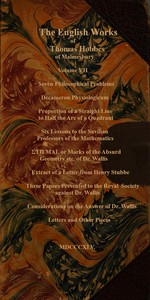
Cover of The English works of Thomas Hobbes of Malmesbury, Volume 07 (of 11)

The English works of Thomas Hobbes of Malmesbury, Volume 07 (of 11)

  • Free to read
  • 9 hours to read
  • 13 chapters

"The English works of Thomas Hobbes of Malmesbury, Volume 07 (of 11)" by Hobbes is a collection of natural philosophy and mathematical treatises written in the mid-17th century. The volume ranges across mechanics, optics, geometry, tides, and weather, and includes Hobbes’s polemics against contemporary mathematicians. It showcases his materialist method: mechanical explanations for natural effects, bold geometric constructions (notably a proposed duplication of the cube), and a sustained critique of the misuse of algebra in geometry. The opening of the volume begins with a royal dedication and a short apology for Leviathan, after which the “Seven Philosophical Problems” unfold as a dialogue between A and B. B advances a unified mechanical physics: gravity and tides arise from large-scale motions that “cast off” air; there is no vacuum, and air‑pump marvels are reinterpreted as strong inflows of air; heat is exhalation from motion, and light a pressure effect on the senses; hardness comes from swift internal reciprocations, explaining elasticity, brittleness, Prince Rupert’s drops, freezing, and the formation of ice. He sketches a meteorology of evaporation, cloud gathering, rain and snow, hail and thunder, accounts for winds and why ships can sail near the wind, and distinguishes reflection, refraction, impact, recoil, and magnetism by shared motions rather than occult qualities. The section culminates in a geometric construction for duplicating the cube and an attack on algebraic “confutations,” arguing they illegitimately mix units (lines, areas, volumes) and thus produce numerical equalities that are false in geometry.

Read free now No app, no sign-up. Your place is saved automatically. Or download for your e-reader ↓
  • Philosophy, English · 17th century

Read the opening

Chapter I: Problems of Gravity

A. What may be the cause, think you, that stones and other bodies thrown upward, or carried up and left to their liberty, fall down again, for aught a man can see, of their own accord? I do not think with the old philosophers, that they have any love to the earth; or are sullen, that they will neither go nor stay. And yet I cannot imagine, what body there is above that should drive them back.

B. For my part, I believe the cause of their descending is not in any natural appetite of the bodies that descend; but rather that the globe of the earth hath some special motion, by which it more easily casteth off the air than it doth other bodies. And then this descent of those we call heavy bodies must of necessity follow, unless there be some empty spaces in the world to receive them. For when the air is thrown off from the earth, somewhat must come into the place of it, in case the world be full: and it must be those things which are hardliest cast off, that is, those things which we say are heavy.

Keep reading The English works of Thomas Hobbes of Malmesbury, Volume 07 (of 11) →

Contents

  1. Front Matter
  2. Chapter I: Problems of Gravity
  3. Chapter II: Problems of Tides
  4. Chapter III: Problems of Vacuum
  5. Chapter IV: Problems of Heat and Light
  6. Chapter V: Problems of Hard and Soft
  7. Chapter VI: Problems of Rain, Wind, and Other Weather
  8. Chapter I: Of the Original of Natural Philosophy
  9. Chapter III: Of Vacuum
  10. Chapter IV: Of the System of the World
  11. Chapter V: Of the Motions of Water and Air
  12. Chapter VI: Of the Causes and Effects of Heat and Cold
  13. Chapter VIII: Of Gravity and Gravitation

Download for your e-reader

Files are provided by Project Gutenberg. On a Kindle, the simplest route is to send the EPUB with Amazon’s Send to Kindle. Downloaded copies don’t sync with your place on Classic Book Reader.

About this edition

This free edition of The English works of Thomas Hobbes of Malmesbury, Volume 07 (of 11) by Thomas Hobbes comes from Project Gutenberg eBook #78674, released 2026-05-13. It is in the public domain in the United States, so you can read it here in full at no cost, on any phone, tablet or computer.

Summary provided by Project Gutenberg (automatically generated).

More by Thomas Hobbes