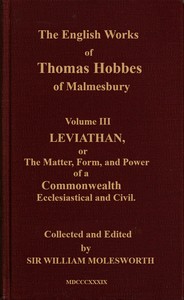
Cover of Leviathan

Leviathan

  • Free to read
  • 14 hours to read
  • 49 chapters
  • Reading level: College-level

"Leviathan" by Thomas Hobbes is a philosophical treatise published in 1651. Written during the English Civil War, it explores the structure of society and legitimate government through social contract theory. Hobbes argues that humanity's natural state is a brutal "war of all against all," driven by individual appetites and the fear of violent death. Only a strong, absolute sovereign can prevent civil war and chaos by uniting both secular and spiritual power. This influential work presents a materialistic view of human nature and political order.

Read free now No app, no sign-up. Your place is saved automatically. Or download for your e-reader ↓
  • Political science · Early works to 1800
  • State, The · Early works to 1800

Read the opening

Chapter I: Of Sense

Concerning the Thoughts of man, I will consider them first Singly, and afterwards in Trayne, or dependance upon one another. Singly, they are every one a Representation or Apparence, of some quality, or other Accident of a body without us; which is commonly called an Object. Which Object worketh on the Eyes, Eares, and other parts of mans body; and by diversity of working, produceth diversity of Apparences.

The Originall of them all, is that which we call Sense; (For there is no conception in a mans mind, which hath not at first, totally, or by parts, been begotten upon the organs of Sense.) The rest are derived from that originall.

To know the naturall cause of Sense, is not very necessary to the business now in hand; and I have els-where written of the same at large. Nevertheless, to fill each part of my present method, I will briefly deliver the same in this place.

The cause of Sense, is the Externall Body, or Object, which presseth the organ proper to each Sense, either immediatly, as in the Tast and Touch; or mediately, as in Seeing, Hearing, and Smelling: which pressure, by the mediation of Nerves, and other strings, and membranes of the body, continued inwards to the Brain, and Heart, causeth there a resistance, or counter-pressure, or endeavour of the heart, to deliver it self: which endeavour because Outward, seemeth to be some matter without. And this Seeming, or Fancy, is that which men call sense; and consisteth, as to the Eye, in a Light, or Colour Figured; To the Eare, in a Sound; To the Nostrill, in an Odour; To the Tongue and Palat, in a Savour; and to the rest of the body, in Heat, Cold, Hardnesse, Softnesse, and such other qualities, as we discern by Feeling. All which qualities called Sensible, are in the object that causeth them, but so many several motions of the matter, by which it presseth our organs diversly. Neither in us that are pressed, are they anything els, but divers motions; (for motion, produceth nothing but motion.) But their apparence to us is Fancy, the same waking, that dreaming. And as pressing, rubbing, or striking the Eye, makes us fancy a light; and pressing the Eare, produceth a dinne; so do the bodies also we see, or hear, produce the same by their strong, though unobserved action, For if those Colours, and Sounds, were in the Bodies, or Objects that cause them, they could not bee severed from them, as by glasses, and in Ecchoes by reflection, wee see they are; where we know the thing we see, is in one place; the apparence, in another. And though at some certain distance, the reall, and very object seem invested with the fancy it begets in us; Yet still the object is one thing, the image or fancy is another. So that Sense in all cases, is nothing els but originall fancy, caused (as I have said) by the pressure, that is, by the motion, of externall things upon our Eyes, Eares, and other organs thereunto ordained.


Keep reading Leviathan →

Contents

Show all 49 chapters
  1. Front Matter
  2. Introduction
  3. Part I: Of Man
  4. Chapter I: Of Sense
  5. Chapter II: Of Imagination
  6. Chapter III: Of the Consequence or Trayne of Imaginations
  7. Chapter IV: Of Speech
  8. Chapter V: Of Reason, and Science
  9. Chapter VI: Of the Interiour Beginnings of Voluntary Motions
  10. Chapter VII: Of the Ends or Resolutions of Discourse
  11. Chapter VIII: Of the Vertues Commonly Called Intellectual; and Their: Contrary Defects
  12. Chapter IX: Of the Severall Subjects of Knowledge
  13. Chapter X: Of Power, Worth, Dignity, Honour and Worthiness
  14. Chapter XI: Of the Difference of Manners
  15. Chapter XII: Of Religion
  16. Chapter XIII: Of the Naturall Condition of Mankind: As Concerning Their Felicity, and Misery
  17. Chapter XIV: Of the First and Second Naturall Lawes, and of Contracts
  18. Chapter XV: Of Other Lawes of Nature
  19. Chapter XVI: Of Persons, Authors, and Things Personated
  20. Part II: Of Common-Wealth
  21. Chapter XVII: Of the Causes, Generation, and Definition of a: Common-Wealth
  22. Chapter XVIII: Of the Rights of Soveraignes by Institution
  23. Chapter XIX: Of the Severall Kinds of Common-Wealth by Institution: And of Succession to the Soveraigne Power
  24. Chapter XX: Of Dominion Paternall and Despoticall
  25. Chapter XXI: Of the Liberty of Subjects
  26. Chapter XXII: Of Systemes Subject, Politicall, and Private
  27. Chapter XXIII: Of the Publique Ministers of Soveraign Power
  28. Chapter XXIV: Of the Nutrition, and Procreation of a Common-Wealth
  29. Chapter XXV: Of Counsell
  30. Chapter XXVI: Of Civill Lawes
  31. Chapter XXVII: Of Crimes, Excuses, and Extenuations
  32. Chapter XXVIII: Of Punishments, and Rewards
  33. Chapter XXIX: Of Those Things That Weaken, or Tend to the Dissolution of: A Common-Wealth
  34. Chapter XXX: Of the Office of the Soveraign Representative
  35. Chapter XXXI: Of the Kingdome of God by Nature
  36. Part III: Of a Christian Common-Wealth
  37. Chapter XXXII: Of the Principles of Christian Politiques
  38. Chapter XXXIII: Of the Number, Antiquity, Scope, Authority, and: Interpreters of the Books of Holy Scripture
  39. Chapter XXXIV: Of the Signification of Spirit, Angel, and Inspiration in: The Books of Holy Scripture
  40. Chapter XXXV: Of the Signification in Scripture of Kingdome of God, of: Holy, Sacred, and Sacrament
  41. Chapter XXXVI: Of the Word of God, and of Prophets
  42. Chapter XXXVII: Of Miracles, and Their Use
  43. Chapter XXXVIII: Of the Signification in Scripture of Eternall Life: Hell, Salvation, the World to Come, and Redemption
  44. Chapter XXXIX: Of the Signification in Scripture of the Word Church
  45. Chapter XL of the Rights of the Kingdome of God, in Abraham, Moses: High Priests, and the Kings of Judah
  46. Chapter XLI: Of the Office of Our Blessed Saviour
  47. Chapter XLII: Of Power Ecclesiasticall
  48. Chapter XLIII: Of What Is Necessary for a Mans Reception into the: Kingdome of Heaven
  49. Part IV: Of the Kingdome of Darknesse
  50. Chapter XLIV: Of Spirituall Darknesse from Misinterpretation of: Scripture
  51. Chapter XLV: Of Daemonology, and Other Reliques of the Religion of the: Gentiles
  52. Chapter XLVI: Of Darknesse from Vain Philosophy, and Fabulous Traditions
  53. Chapter XLVII: Of the Benefit That Proceedeth from Such Darknesse, and: To Whom It Accreweth

Download for your e-reader

Files are provided by Project Gutenberg. On a Kindle, the simplest route is to send the EPUB with Amazon’s Send to Kindle. Downloaded copies don’t sync with your place on Classic Book Reader.

About this edition

This free edition of Leviathan by Thomas Hobbes comes from Project Gutenberg eBook #3207, released 2002-05-01. It is in the public domain in the United States, so you can read it here in full at no cost, on any phone, tablet or computer. Genre: History - Early Modern (c. 1450-1750), Philosophy & Ethics.

Summary provided by Project Gutenberg (automatically generated).

More by Thomas Hobbes