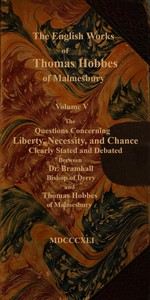
Cover of The English works of Thomas Hobbes of Malmesbury, Volume 05 (of 11)

The English works of Thomas Hobbes of Malmesbury, Volume 05 (of 11)

  • Free to read
  • 9 hours to read
  • 70 chapters
  • Reading level: 8th & 9th grade

"The English works of Thomas Hobbes of Malmesbury, Volume 05 (of 11)" by Hobbes is a collection of philosophical writings written in the mid-19th century. This volume focuses on the classic debate over free will, determinism, and chance, centering on Hobbes’s exchange with Bishop John Bramhall. It contrasts Hobbes’s thoroughgoing necessity—grounded in divine will, causation, and foreknowledge—with Bramhall’s defense of a genuinely free human will, drawing on Scripture, scholastic theology, and practical reasoning. Readers can expect a sharp, source-rich controversy about moral responsibility, divine justice, and human action. The opening of the volume sets the stage with Hobbes’s brief address to the reader and a clear statement of the dispute: both sides agree people are free to do what they will, but they split on whether one can be free to will what one wills. Hobbes outlines the “state of the question,” distinguishing freedom to act from freedom to will, and lists four sources of argument—authority (especially Scripture), practical consequences, divine attributes, and natural reason—before citing extensive biblical support for necessity and reconciling texts that seem to oppose it. He challenges scholastic “permission” doctrines, separates God’s revealed will from His decree, and argues that God’s foreknowledge entails necessity, while countering the charge that necessity destroys law, prudence, or piety. The text then turns polemical: Bramhall denounces necessity as destructive, defends traditional distinctions (liberty of exercise vs. contrariety), and accuses Hobbes of evasions, while Hobbes replies point by point, insisting on the difference between being free to act and being free to will, using examples (like dice throws) to argue that effects follow necessarily from causes.

Read free now No app, no sign-up. Your place is saved automatically. Or download for your e-reader ↓
  • Philosophy, English · 17th century
Read the opening

Liberty, Necessity, and Chance

Whether whatsoever comes to pass proceed from necessity, or some things from chance, has been a question disputed amongst the old philosophers long time before the incarnation of our Saviour, without drawing into argument on either side the almighty power of the Deity. But the third way of bringing things to pass, distinct from necessity and chance, namely, freewill, is a thing that never was mentioned amongst them, nor by the Christians in the beginning of Christianity. For St. Paul, that disputes that question largely and purposely, never useth the term of freewill; nor did he hold any doctrine equivalent to that which is now called the doctrine of freewill; but deriveth all actions from the irresistible will of God, and nothing from the will of him that runneth or willeth. But for some ages past, the doctors of the Roman Church have exempted from this dominion of God’s will the will of man; and brought in a doctrine, that not only man, but also his will is free, and determined to this or that action, not by the will of God, nor necessary causes, but by the power of the will itself. And though by the reformed Churches instructed by Luther, Calvin, and others, this opinion was cast out, yet not many years since it began again to be reduced by Arminius and his followers, and became the readiest way to ecclesiastical promotion; and by discontenting those that held the contrary, was in some part the cause of the following troubles; which troubles were the occasion of my meeting with the Bishop of Derry at Paris, where we discoursed together of the argument now in hand; from which discourse we carried away each of us his own opinion, and for aught I remember, without any offensive words, as blasphemous, atheistical, or the like, passing between us; either for that the Bishop was not then in passion, or suppressed his passion, being then in the presence of my Lord of Newcastle.

Keep reading The English works of Thomas Hobbes of Malmesbury, Volume 05 (of 11) →

Contents

Show all 70 chapters
  1. Front Matter
  2. Liberty, Necessity, and Chance
  3. The State of the Question
  4. The Fountains of Argument in This Question
  5. To the Reader
  6. Antecedent and Extrinsical Necessity
  7. Animadversions Upon the Bishop’s Reply No. I
  8. Animadversions Upon His Reply No. II
  9. No. III
  10. Animadversions Upon His Reply No. III
  11. Animadversions Upon the Bishop’s Reply No. IV
  12. Proofs of Liberty Out of Scripture. — No. VI
  13. Animadversions Upon the Bishop’s Reply No. VI
  14. No. VII
  15. Animadversions Upon the Bishop’s Reply No. VII
  16. No. VIII
  17. Animadversions Upon the Bishop’s Reply No. VIII
  18. Animadversions Upon the Bishop’s Reply No. IX
  19. Animadversions Upon the Bishop’s Reply No. X
  20. Animadversions Upon the Bishop’s Reply No. XI
  21. No. XII
  22. Animadversions Upon the Bishop’s Reply No. XII
  23. Proofs of Liberty Drawn from Reason. No. XIII
  24. No. XIV
  25. Animadversions Upon the Bishop’s Reply No. XIV
  26. Animadversions Upon the Bishop’s Reply No. XV
  27. No. XVI
  28. Animadversions Upon the Bishop’s Reply No. XVI
  29. No. XVII
  30. Animadversions Upon the Bishop’s Reply No. XVII
  31. No. XVIII
  32. Animadversions Upon the Bishop’s Reply No. XVIII
  33. No. XIX
  34. Animadversions Upon the Bishop’s Reply No. XIX
  35. Animadversions Upon the Bishop’s Reply No. XX
  36. No. XXI
  37. Animadversions Upon the Bishop’s Reply No. XXI
  38. No. XXII
  39. Animadversions Upon the Bishop’s Reply No. XXII
  40. No. XXIII
  41. Animadversions Upon the Bishop’s Reply No. XXIII
  42. No. XXIV
  43. Animadversions Upon the Bishop’s Reply, No. XXIV
  44. My Opinion About Liberty and Necessity No. XXV
  45. No. XXVI
  46. Animadversions Upon the Answer to No. XXVI
  47. No. XXVII
  48. Animadversions Upon the Answer to No. XXVII
  49. No. XXVIII
  50. Animadversions Upon the Answer to No. XXVIII
  51. No. XXIX
  52. Animadversions Upon the Answer to No. XXIX
  53. No. XXX
  54. Animadversions Upon the Answer to No. XXX
  55. No. XXXI
  56. Animadversions Upon the Answer to No. XXXI
  57. No. XXXII
  58. Animadversions Upon the Answer to No. XXXII
  59. No. XXXIII
  60. Animadversions Upon the Answer to No. XXXIII
  61. No. XXXIV
  62. Animadversions Upon the Answer to No. XXXIV
  63. No. XXXV
  64. Animadversions Upon the Answer to No. XXXV
  65. No. XXXVI
  66. Animadversions Upon the Answer to No. XXXVI
  67. No. XXXVII
  68. Animadversions Upon the Answer to No. XXXVII
  69. No. XXXVIII
  70. End of Vol. V

Download for your e-reader

Files are provided by Project Gutenberg. On a Kindle, the simplest route is to send the EPUB with Amazon’s Send to Kindle. Downloaded copies don’t sync with your place on Classic Book Reader.

About this edition

This free edition of The English works of Thomas Hobbes of Malmesbury, Volume 05 (of 11) by Thomas Hobbes comes from Project Gutenberg eBook #76650, released 2025-08-08. It is in the public domain in the United States, so you can read it here in full at no cost, on any phone, tablet or computer. Genre: Philosophy & Ethics, Religion/Spirituality.

Summary provided by Project Gutenberg (automatically generated).

More by Thomas Hobbes