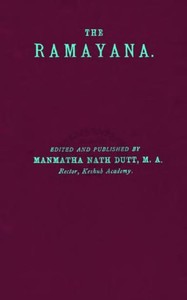
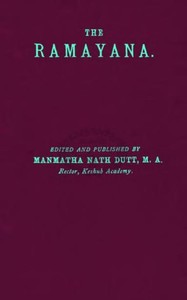
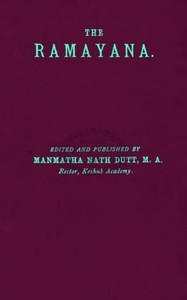
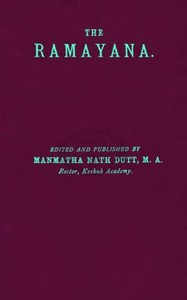
Cover of The Rāmāyana, Volume 1. Bālakāndam and Ayodhyākāndam

The Rāmāyana, Volume 1. Bālakāndam and Ayodhyākāndam

  • Free to read
  • 11 hours to read
  • 194 chapters
  • Reading level: 8th & 9th grade

"The Rāmāyana, Volume 1. Bālakāndam and Ayodhyākāndam" by Valmiki is a Sanskrit epic with its earliest portions composed between the 7th and 5th centuries BCE. This ancient Hindu text follows Prince Rama's fourteen-year exile from his kingdom of Ayodhya, accompanied by his wife Sita and brother Lakshmana. Their forest journey leads to Sita's kidnapping by Ravana, king of Lanka, setting in motion a conflict that will test virtue, loyalty, and duty before Rama's eventual return home.

Read free now No app, no sign-up. Your place is saved automatically. Or download for your e-reader ↓
  • Folklore · India
  • Rama (Hindu deity)
  • Epic poetry, Sanskrit · Translations into English
  • Valmiki · Adaptations

Read the opening

Section I

The ascetic Valmiki asked that best of sages and foremost of those conversant with words, ever engaged in austerities and Vaidika studies, Narada saying,—"Who at present in this world is alike crowned with qualities, and endued with prowess, knowing duty, and grateful, and truthful, and firm in vow,—who is qualified by virtue of his character, and who is ever studious of the welfare of all creatures? Who is learned, hath studied society, and knoweth the art of pleasing his subjects? And who alone is ever lovely to behold? Who hath subdued his heart, and controlled his anger, is endowed with personal grace, and devoid of malice; and whom, enraged in battle, do even the gods, fear? Great is my curiosity to hear of such a person. Thou canst, O Maharshi[1] tell me of a man of this description." Hearing Valmiki's words, Narada, cognizant of the three worlds, said with alacrity,—"Do thou listen! Rare as are the qualities mentioned by thee, I will, O sage, having duly considered, describe unto thee a person endued with them. There is one sprung from the line of Ikshwaku, known by the name of Rama. He is of subdued soul and exceeding prowess; effulgent; endowed with patience; having senses under control; intelligent; learned in morality; eloquent; crowned with grace; the slayer of foes; broad-shouldered; possessed of mighty arms, a conch-shaped neck, fleshy jaws, and a broad chest; a powerful bowman; the repressor of foes; having plump shoulder-blades; of arms reaching down unto his knees; with a beautiful head, and a graceful forehead; and endowed with excellent might; having symmetrical limbs; and of a cool hue; and possessed of prowess; and having a well- developed chest; with expansive eyes; crowned with auspiciousness and favourable marks; knowing duty; firm in promise; aye engaged in the good of his subjects; of accomplished renown; furnished with knowledge; pure in body and spirit; modest towards superiors; versed in self-knowledge; like unto Prajapati himself; blest with prosperity; protecting all; the destroyer of enemies, and supporter of all living beings; and the stay of order, practising all the duties of his class; and preserving those cleaving unto him; versed in the profundities of the Vedas and the Vedangas; accomplished in archery; gifted with a good memory; ascertaining with rapidity the truth of things; the darling of all; unreproved; of unvanquished spirit; discerning; proficient in every branch of learning; ever resorted to by the good even as the ocean is, by the rivers; worthy of being honored; having an equal regard for all; and capable of filling the heart with ever-new sensations. Crowned with every grace; he enhanceth the joys of Kaucalya; being like unto the sea in gravity, and unto the Himavat in patience. In prowess, he is like unto Vishnu, and boasteth of the personal attractions of the Moon. In anger he resembleth the fire raging at the dissolution of all; and in forgiveness, he is like unto the Earth. In giving away, he is like unto (Kuvera) the Bestower of riches, and in truth, he is like another Dharma.

Keep reading The Rāmāyana, Volume 1. Bālakāndam and Ayodhyākāndam →

Contents

Show all 194 chapters
  1. Front Matter
  2. Section I
  3. Section II
  4. Section III
  5. Section IV
  6. Section V
  7. Section VI
  8. Section VII
  9. Section VIII
  10. Section IX
  11. Section X
  12. Section XI
  13. Section XII
  14. Section XIII
  15. Section XIV
  16. Section XV
  17. Section XVI
  18. Section XVII
  19. Section XVIII
  20. Section XIX
  21. Section XX
  22. Section XXI
  23. Section XXII
  24. Section XXIII
  25. Section XXIV
  26. Section XXV
  27. Section XXVI
  28. Section XXVII
  29. Section XXVIII
  30. Section XXIX
  31. Section XXX
  32. Section XXXI
  33. Section XXXIII
  34. Section XXXIV
  35. Section XXXV
  36. Section XXXVI
  37. Section XXXVII
  38. Section XXXVIII
  39. Section XXXIX
  40. Section XL
  41. Section XLI
  42. Section XLII
  43. Section XLIV
  44. Section XLV
  45. Section XLVI
  46. Section XLVII
  47. Section XLVIII
  48. Section XLIX
  49. Section L
  50. Section LI
  51. Section LII
  52. Section LIII
  53. Section LIV
  54. Section LV
  55. Section LVI
  56. Section LVII
  57. Section LVIII
  58. Section LIX
  59. Section LX
  60. Section LXI
  61. Section LXII
  62. Section LXIII
  63. Section LXIV
  64. Section LXV
  65. Section LXVI
  66. Section LXVII
  67. Section LXVIII
  68. Section LXIX
  69. Section LXX
  70. Section LXXI
  71. Section LXXII
  72. Section LXXII
  73. Section LXXIV
  74. Section LXXV
  75. Section LXXVI
  76. Section LXXVII
  77. Section I
  78. Section II
  79. Section III
  80. Section IV
  81. Section V
  82. Section VI
  83. Section VII
  84. Section VIII
  85. Section IX
  86. Section X
  87. Section XI
  88. Section XII
  89. Section XIII
  90. Section XIV
  91. Section XV
  92. Section XVI
  93. Section XVII
  94. Section XVIII
  95. Section XIX
  96. Section XX
  97. Section XXI
  98. Section XXII
  99. Section XXIII
  100. Section XXIV
  101. Section XXV
  102. Section XXVI
  103. Section XXVII
  104. Section XXVIII
  105. Section XXIX
  106. Section XXX
  107. Section XXXI
  108. Section XXXII
  109. Section XXXIII
  110. Section XXXIV
  111. Section XXXV
  112. Section XXXVI
  113. Section XXXVII
  114. Section XXXVIII
  115. Section XXXIX
  116. Section XL
  117. Section XLI
  118. Section XLII
  119. Section XLIII
  120. Section XLIV
  121. Section XLV
  122. Section XLVI
  123. Section XLVII
  124. Section XLVIII
  125. Section XLIX
  126. Section L
  127. Section LI
  128. Section LII
  129. Section LIII
  130. Section LIV
  131. Section LV
  132. Section LVI
  133. Section LVII
  134. Section LVIII
  135. Section LIX
  136. Section LX
  137. Section LXI
  138. Section LXII
  139. Section LXIII
  140. Section LXIV
  141. Section LXV
  142. Section LXVI
  143. Section LXVII
  144. Section LXVIII
  145. Section LXIX
  146. Section LXX
  147. Section LXXI
  148. Section LXXII
  149. Section LXXIII
  150. Section LXXIV
  151. Section LXXV
  152. Section LXXVI
  153. Section LXXVII
  154. Section LXXVIII
  155. Section LXXIX
  156. Section LXXX
  157. Section LXXXI
  158. Section LXXXII
  159. Section LXXXIII
  160. Section LXXXIV
  161. Section LXXXV
  162. Section LXXXVI
  163. Section LXXXVII
  164. Section LXXXVIII
  165. Section LXXXIX
  166. Section Lxxxx
  167. Section Lxxxxi
  168. Section Lxxxxii
  169. Section Lxxxxiii
  170. Section Lxxxxiv
  171. Section Lxxxxv
  172. Section Lxxxxvi
  173. Section Lxxxxvii
  174. Section Lxxxxviii
  175. Section Lxxxxix
  176. Section C
  177. Section CI
  178. Section CII
  179. Section CIII
  180. Section CIV
  181. Section CV
  182. Section CVI
  183. Section CVII
  184. Section CVIII
  185. Section CIX
  186. Section CX
  187. Section CXI
  188. Section CXII
  189. Section CXIII
  190. Section CXIV
  191. Section CXV
  192. Section CXVI
  193. Section CXVII
  194. Section CXVIII

Download for your e-reader

Files are provided by Project Gutenberg. On a Kindle, the simplest route is to send the EPUB with Amazon’s Send to Kindle. Downloaded copies don’t sync with your place on Classic Book Reader.

About this edition

This free edition of The Rāmāyana, Volume 1. Bālakāndam and Ayodhyākāndam by Valmiki comes from Project Gutenberg eBook #57265, released 2018-06-03. It is in the public domain in the United States, so you can read it here in full at no cost, on any phone, tablet or computer. Genre: Mythology, Legends & Folklore.

Summary provided by Project Gutenberg (automatically generated).

More by Valmiki