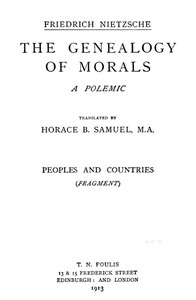
Cover of The Genealogy of Morals

The Genealogy of Morals

  • Free to read
  • 4 hours to read
  • 99 chapters
  • Reading level: College-level

"The Genealogy of Morals" by Friedrich Wilhelm Nietzsche is a philosophical work published in 1887. Consisting of three interrelated treatises, it traces the evolution of moral concepts to challenge what Nietzsche views as moral prejudices, particularly those of Christianity and Judaism. Through historical analysis, Nietzsche examines how opposing value systems—"good and evil" versus "good and bad"—emerged from different social classes. He explores the aristocratic morality of the powerful and the "slave morality" born from resentment, revealing how values became inverted throughout history.

Read free now No app, no sign-up. Your place is saved automatically. Or download for your e-reader ↓
  • Ethics

Read the opening

Chapter 1

We are unknown, we knowers, ourselves to ourselves: this has its own good reason. We have never searched for ourselves—how should it then come to pass, that we should ever find ourselves? Rightly has it been said: "Where your treasure is, there will your heart be also." Our treasure is there, where stand the hives of our knowledge. It is to those hives that we are always striving; as born creatures of flight, and as the honey-gatherers of the spirit, we care really in our hearts only for one thing—to bring something "home to the hive!"

As far as the rest of life with its so-called "experiences" is concerned, which of us has even sufficient serious interest? or sufficient time? In our dealings with such points of life, we are, I fear, never properly to the point; to be precise, our heart is not there, and certainly not our ear. Rather like one who, delighting in a divine distraction, or sunken in the seas of his own soul, in whose ear the clock has just thundered with all its force its twelve strokes of noon, suddenly wakes up, and asks himself, "What has in point of fact just struck?" so do we at times rub afterwards, as it were, our puzzled ears, and ask in complete astonishment and complete embarrassment, "Through what have we in point of fact just lived?" further, "Who are we in point of fact?" and count, after they have struck, as I have explained, all the twelve throbbing beats of the clock of our experience, of our life, of our being—ah!—and count wrong in the endeavour. Of necessity we remain strangers to ourselves, we understand ourselves not, in ourselves we are bound to be mistaken, for of us holds good to all eternity the motto, "Each one is the farthest away from himself"—as far as ourselves are concerned we are not "knowers."

Keep reading The Genealogy of Morals →

Contents

Show all 99 chapters
  1. Chapter 1
  2. Chapter 2
  3. Chapter 3
  4. Chapter 4
  5. Chapter 5
  6. Chapter 6
  7. Chapter 7
  8. Chapter 8
  9. Chapter 1
  10. Chapter 2
  11. Chapter 3
  12. Chapter 4
  13. Chapter 5
  14. Chapter 6
  15. Chapter 7
  16. Chapter 8
  17. Chapter 9
  18. Chapter 10
  19. Chapter 11
  20. Chapter 12
  21. Chapter 13
  22. Chapter 14
  23. Chapter 15
  24. Chapter 16
  25. Chapter 17
  26. Chapter 1
  27. Chapter 2
  28. Chapter 3
  29. Chapter 4
  30. Chapter 5
  31. Chapter 6
  32. Chapter 7
  33. Chapter 8
  34. Chapter 9
  35. Chapter 10
  36. Chapter 11
  37. Chapter 12
  38. Chapter 13
  39. Chapter 14
  40. Chapter 15
  41. Chapter 16
  42. Chapter 17
  43. Chapter 18
  44. Chapter 19
  45. Chapter 20
  46. Chapter 21
  47. Chapter 22
  48. Chapter 23
  49. Chapter 24
  50. Chapter 25
  51. Chapter 1
  52. Chapter 2
  53. Chapter 3
  54. Chapter 4
  55. Chapter 5
  56. Chapter 6
  57. Chapter 7
  58. Chapter 8
  59. Chapter 9
  60. Chapter 10
  61. Chapter 11
  62. Chapter 12
  63. Chapter 13
  64. Chapter 14
  65. Chapter 15
  66. Chapter 16
  67. Chapter 17
  68. Chapter 18
  69. Chapter 19
  70. Chapter 20
  71. Chapter 21
  72. Chapter 22
  73. Chapter 23
  74. Chapter 24
  75. Chapter 25
  76. Chapter 26
  77. Chapter 27
  78. Chapter 28
  79. Chapter 2
  80. Chapter 3
  81. Chapter 4
  82. Chapter 5
  83. Chapter 6
  84. Chapter 7
  85. Chapter 8
  86. Chapter 9
  87. Chapter 10
  88. Chapter 11
  89. Chapter 12
  90. Chapter 13
  91. Chapter 15
  92. Chapter 16
  93. Chapter 17
  94. Chapter 18
  95. Chapter 19
  96. Chapter 23
  97. Chapter 25
  98. Chapter 26
  99. Chapter 27

Download for your e-reader

Files are provided by Project Gutenberg. On a Kindle, the simplest route is to send the EPUB with Amazon’s Send to Kindle. Downloaded copies don’t sync with your place on Classic Book Reader.

About this edition

This free edition of The Genealogy of Morals by Friedrich Wilhelm Nietzsche comes from Project Gutenberg eBook #52319, released 2016-06-13. It is in the public domain in the United States, so you can read it here in full at no cost, on any phone, tablet or computer. Genre: Philosophy & Ethics.

Summary provided by Project Gutenberg (automatically generated).

More by Friedrich Wilhelm Nietzsche