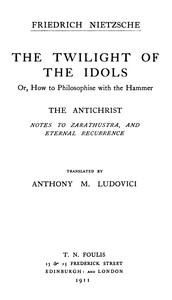
Cover of The Antichrist

The Antichrist

  • Free to read
  • 2 hours to read
  • 64 chapters
  • Reading level: 10th to 12th grade

"The Antichrist" by Friedrich Wilhelm Nietzsche is a philosophical work written in 1888 and published in 1895. Nietzsche launches a fierce critique of Christianity and modern values, arguing they spring from weakness rather than strength. He attacks Christian concepts of pity, morality, and God as life-denying forces that celebrate decline over vitality. Contrasting Christianity with Buddhism and examining the origins of religious power, Nietzsche advocates for a transvaluation of values based on the will to power rather than compassion.

Read free now No app, no sign-up. Your place is saved automatically. Or download for your e-reader ↓
  • Christianity · Controversial literature

Read the opening

Chapter 1

—Let us look each other in the face. We are Hyperboreans—we know well enough how remote our place is. "Neither by land nor by water will you find the road to the Hyperboreans": even Pindar,[1] in his day, knew that much about us. Beyond the North, beyond the ice, beyond death—our life, our happiness.... We have discovered that happiness; we know the way; we got our knowledge of it from thousands of years in the labyrinth. Who else has found it?—The man of today?—"I don't know either the way out or the way in; I am whatever doesn't know either the way out or the way in"—so sighs the man of today.... This is the sort of modernity that made us ill,—we sickened on lazy peace, cowardly compromise, the whole virtuous dirtiness of the modern Yea and Nay. This tolerance and largeur of the heart that "forgives" everything because it "understands" everything is a sirocco to us. Rather live amid the ice than among modern virtues and other such south-winds!... We were brave enough; we spared neither ourselves nor others; but we were a long time finding out where to direct our courage. We grew dismal; they called us fatalists. Our fate—it was the fulness, the tension, the storing up of powers. We thirsted for the lightnings and great deeds; we kept as far as possible from the happiness of the weakling, from "resignation"... There was thunder in our air; nature, as we embodied it, became overcast—for we had not yet found the way. The formula of our happiness: a Yea, a Nay, a straight line, a goal....

Keep reading The Antichrist →

Contents

Show all 64 chapters
  1. Introduction
  2. Preface
  3. Chapter 1
  4. Chapter 2
  5. Chapter 3
  6. Chapter 4
  7. Chapter 5
  8. Chapter 6
  9. Chapter 7
  10. Chapter 8
  11. Chapter 9
  12. Chapter 10
  13. Chapter 11
  14. Chapter 12
  15. Chapter 13
  16. Chapter 14
  17. Chapter 15
  18. Chapter 16
  19. Chapter 17
  20. Chapter 18
  21. Chapter 19
  22. Chapter 20
  23. Chapter 21
  24. Chapter 22
  25. Chapter 23
  26. Chapter 24
  27. Chapter 25
  28. Chapter 26
  29. Chapter 27
  30. Chapter 28
  31. Chapter 29
  32. Chapter 30
  33. Chapter 31
  34. Chapter 32
  35. Chapter 33
  36. Chapter 34
  37. Chapter 35
  38. Chapter 36
  39. Chapter 37
  40. Chapter 38
  41. Chapter 39
  42. Chapter 40
  43. Chapter 41
  44. Chapter 42
  45. Chapter 43
  46. Chapter 44
  47. Chapter 45
  48. Chapter 46
  49. Chapter 47
  50. Chapter 48
  51. Chapter 49
  52. Chapter 50
  53. Chapter 51
  54. Chapter 52
  55. Chapter 53
  56. Chapter 54
  57. Chapter 55
  58. Chapter 56
  59. Chapter 57
  60. Chapter 58
  61. Chapter 59
  62. Chapter 60
  63. Chapter 61
  64. Chapter 62

Download for your e-reader

Files are provided by Project Gutenberg. On a Kindle, the simplest route is to send the EPUB with Amazon’s Send to Kindle. Downloaded copies don’t sync with your place on Classic Book Reader.

About this edition

This free edition of The Antichrist by Friedrich Wilhelm Nietzsche comes from Project Gutenberg eBook #19322, released 2006-09-18. It is in the public domain in the United States, so you can read it here in full at no cost, on any phone, tablet or computer. Genre: Philosophy & Ethics, Religion/Spirituality.

Summary provided by Project Gutenberg (automatically generated).

More by Friedrich Wilhelm Nietzsche