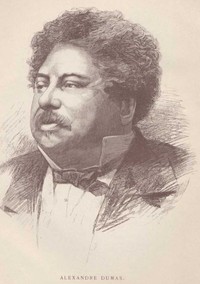
Cover of Karl Ludwig Sand

Karl Ludwig Sand

  • Free to read
  • 2 hours to read
  • Reading level: 8th & 9th grade

"Karl Ludwig Sand" by Alexandre Dumas is a historical account likely written in the early 19th century. The book tells the tragic story of Karl Ludwig Sand, a young German student who becomes embroiled in the political turmoil of post-Napoleonic Germany and ultimately commits the act of assassinating the playwright August von Kotzebue, whom he views as a traitor to his country. The narrative explores Sand's youth, his ideological motivations, and the complex interplay of personal and nationalistic fervor that lead him to take drastic measures. The opening of the book introduces us to Karl Ludwig Sand as he begins his journey towards Mannheim with the intent to assassinate Kotzebue. It provides detailed insights into Sand's background, painting a portrait of a sensitive yet determined young man marked by physical ailments due to childhood illnesses. We learn of his deep sense of duty to his country and the burden he feels in the face of its political state. Through early anecdotes showcasing his courageous spirit and moral convictions, we come to grasp the forming ideologies that drive him. Significant reflections in his journal convey his evolving thoughts towards the assassination act, highlighting his determination to act for the greater good, albeit through violent means. This initial section sets the stage for an exploration of ethical dilemmas surrounding patriotism and the sacrifices made in the name of national integrity.

Read free now No app, no sign-up. Your place is saved automatically. Or download for your e-reader ↓
  • Crime

Read the opening

Produced by David Widger.

*KARL-LUDWIG SAND—1819*

*KARL-LUDWIG SAND—1819*

On the 22nd of March, 1819, about nine o'clock in the morning, a young man, some twenty-three or twenty-four years old, wearing the dress of a German student, which consists of a short frock-coat with silk braiding, tight trousers, and high boots, paused upon a little eminence that stands upon the road between Kaiserthal and Mannheim, at about three-quarters of the distance from the former town, and commands a view of the latter. Mannheim is seen rising calm and smiling amid gardens which once were ramparts, and which now surround and embrace it like a girdle of foliage and flowers. Having reached this spot, he lifted his cap, above the peak of which were embroidered three interlaced oak leaves in silver, and uncovering his brow, stood bareheaded for a moment to feel the fresh air that rose from the valley of the Neckar. At first sight his irregular features produced a strange impression; but before long the pallor of his face, deeply marked by smallpox, the infinite gentleness of his eyes, and the elegant framework of his long and flowing black hair, which grew in an admirable curve around a broad, high forehead, attracted towards him that emotion of sad sympathy to which we yield without inquiring its reason or dreaming of resistance. Though it was still early, he seemed already to have come some distance, for his boots were covered with dust; but no doubt he was nearing his destination, for, letting his cap drop, and hooking into his belt his long pipe, that inseparable companion of the German Borsch, he drew from his pocket a little note-book, and wrote in it with a pencil: "Left Wanheim at five in the morning, came in sight of Mannheim at a quarter-past nine." Then putting his note-book back into his pocket, he stood motionless for a moment, his lips moving as though in mental prayer, picked up his hat, and walked on again with a firm step towards Mannheim.

Keep reading Karl Ludwig Sand →

Download for your e-reader

Files are provided by Project Gutenberg. On a Kindle, the simplest route is to send the EPUB with Amazon’s Send to Kindle. Downloaded copies don’t sync with your place on Classic Book Reader.

About this edition

This free edition of Karl Ludwig Sand by Alexandre Dumas comes from Project Gutenberg eBook #2745, released 2004-09-22. It is in the public domain in the United States, so you can read it here in full at no cost, on any phone, tablet or computer. Genre: Biographies, History - European.

Summary provided by Project Gutenberg (automatically generated).

More by Alexandre Dumas