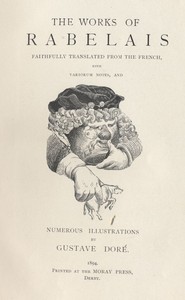
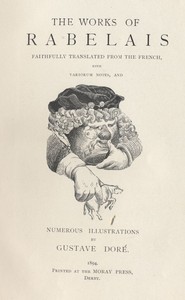
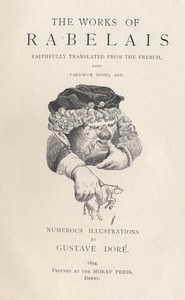
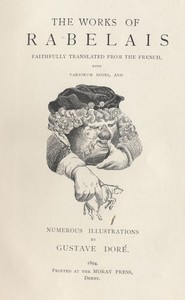
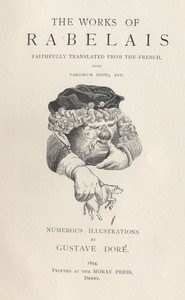
Gargantua and Pantagruel, Illustrated, Book 3
by François Rabelais (1832–1883)
- Free to read
- 6 hours to read
- 53 chapters
- Reading level: 10th to 12th grade
"Gargantua and Pantagruel, Illustrated, Book 3" by François Rabelais is a novel written in the 16th century. After settling Panurge's debts, Pantagruel faces a new challenge: his companion suddenly wants to marry but cannot decide if he should. They consult fortune-tellers, scholars, poets, and philosophers, yet Panurge rejects every answer. Finally, they resolve to seek wisdom from the Divine Bottle itself, setting sail on an extraordinary voyage that will test their wits and friendship.
- Giants
- Fantasy fiction, French · Translations into English
- Gargantua (Legendary character)
Read the opening
Book III
Translated into English by
Sir Thomas Urquhart of Cromarty
and
Peter Antony Motteux
The text of the first Two Books of Rabelais has been reprinted from the first edition (1653) of Urquhart's translation. Footnotes initialled 'M.' are drawn from the Maitland Club edition (1838); other footnotes are by the translator. Urquhart's translation of Book III. appeared posthumously in 1693, with a new edition of Books I. and II., under Motteux's editorship. Motteux's rendering of Books IV. and V. followed in 1708. Occasionally (as the footnotes indicate) passages omitted by Motteux have been restored from the 1738 copy edited by Ozell.
Keep reading Gargantua and Pantagruel, Illustrated, Book 3 →
Download for your e-reader
Files are provided by Project Gutenberg. On a Kindle, the simplest route is to send the EPUB with Amazon’s Send to Kindle. Downloaded copies don’t sync with your place on Classic Book Reader.
About this edition
This free edition of Gargantua and Pantagruel, Illustrated, Book 3 by François Rabelais comes from Project Gutenberg eBook #8168, released 2004-08-08. It is in the public domain in the United States, so you can read it here in full at no cost, on any phone, tablet or computer. Genre: Humour, Novels, French Literature.
Summary provided by Project Gutenberg (automatically generated).
More by François Rabelais