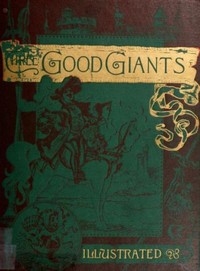
Cover of Three Good Giants

Three Good Giants

  • Free to read
  • 4 hours to read
  • 45 chapters
  • Reading level: 7th grade

"Three Good Giants" by François Rabelais is a fictional compilation written in the late 19th century, adapted by John Dimitry. This work appears to be a whimsical retelling of the famed giants from Rabelais's original novels, particularly focusing on Grandgousier, Gargantua, and Pantagruel. Through their humorous and larger-than-life adventures, the story likely intertwines themes of merriment, folly, and the unexpected nature of these colossal characters, presenting them in a far more positive and entertaining light than they have sometimes been portrayed. The opening of the tale introduces readers to the origins of the giants, tracing their lineage back to a mythical past where their existence coincides with the "Year of Medlars." It describes how ordinary humans, after overindulging in this delicious fruit, began to grow into giants. The first of these giants, Chalbroth, sets the stage for a long line leading to King Grandgousier, who embodies joviality and generosity. The narrative tonally balances between humor, the absurdities of life, and the heartwarming relationships among its characters, effectively inviting readers into a fantastical world where giants react with remarkably human-like impulses and emotions.

Read free now No app, no sign-up. Your place is saved automatically. Or download for your e-reader ↓
  • Fantasy fiction
  • Conduct of life
  • Children · Conduct of life
  • Islands
  • Death
  • Giants
  • Kings and rulers
  • Clergy

Read the opening

Chapter XLIII

Pantagruel, with his Darts, kills a Monster which Cannon-Balls could not hurt. The Power of the Sign of the Cross.

Which tells of several Islands, and the Wonderful People who dwell in them.

FULL-PAGE ILLUSTRATIONS.

GARGANTUA ON THE TOWER OF NÔTRE DÂME.

FRIAR JOHN ATTACKS THE BUNMAKERS.

Keep reading Three Good Giants →

Contents

Show all 45 chapters
  1. Front Matter
  2. Chapter XLIII
  3. Chapter I
  4. Chapter II
  5. Chapter III
  6. Chapter IV
  7. Chapter V: The Year Gargantua Had Wooden Horses, and What Use He Made of Them
  8. Chapter VI
  9. Chapter VII
  10. Chapter VIII: Gargantua Goes to Paris, and the Big Mare That Takes Him There
  11. Chapter IX
  12. Chapter X
  13. Chapter XI
  14. Chapter XII
  15. Chapter XIII
  16. Chapter XIV
  17. Chapter XV
  18. Chapter XVI: How Grandgousier Tried to Buy Peace with Five Cart-Loads of Buns
  19. Chapter XVII
  20. Chapter XVIII
  21. Chapter XIX
  22. Chapter XX
  23. Chapter XXI
  24. Chapter XXII: Grandgousier's Death. — Gargantua's Marriage. — Pantagruel Is Born
  25. Chapter XXIII
  26. Chapter XXIV: After Studying at Several Universities Pantagruel Goes to Paris
  27. Chapter XXV
  28. Chapter XXVI
  29. Chapter XXVII
  30. Chapter XXVIII: Showing Why the Leagues Are So Much Shorter in France Than in Germany
  31. Chapter XXIX
  32. Chapter XXX: How Carpalim Went Hunting for Fresh Meat, and How a Trophy Was Set Up
  33. Chapter XXXI
  34. Chapter XXXII
  35. Chapter XXXIII
  36. Chapter XXXIV
  37. Chapter XXXV: Pantagruel Starts on His Travels, and Lands at the Island of Pictures
  38. Chapter XXXVI: Panurge Bargains with Dindeno for a Ram, and Throws His Ram Overboard
  39. Chapter XXXVII
  40. Chapter XXXVIII
  41. Chapter XXXIX
  42. Chapter XL
  43. Chapter XLI
  44. Chapter XLII
  45. Chapter XLIII

Download for your e-reader

Files are provided by Project Gutenberg. On a Kindle, the simplest route is to send the EPUB with Amazon’s Send to Kindle. Downloaded copies don’t sync with your place on Classic Book Reader.

About this edition

This free edition of Three Good Giants by François Rabelais comes from Project Gutenberg eBook #59235, released 2019-04-09. It is in the public domain in the United States, so you can read it here in full at no cost, on any phone, tablet or computer. Genre: Science-Fiction & Fantasy, Humour, Mythology, Legends & Folklore, French Literature.

Summary provided by Project Gutenberg (automatically generated).

More by François Rabelais