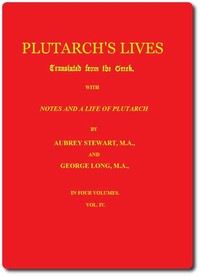
Cover of Plutarch: Lives of the noble Grecians and Romans

Plutarch: Lives of the noble Grecians and Romans

  • Free to read
  • 49 hours to read
  • 67 chapters
  • Reading level: College-level

"Plutarch: Lives of the noble Grecians and Romans" by Plutarch is a series of biographies written in Greek probably at the beginning of the second century. This monumental work pairs famous Greeks with Romans of similar destiny—Alexander with Caesar, Demosthenes with Cicero—to illuminate their moral virtues and failings. Rather than pure history, Plutarch crafted ethical portraits exploring how character shaped the lives of great men. Twenty-three paired biographies survive, alongside four singular lives, offering timeless lessons through comparison and moral examination.

Read free now No app, no sign-up. Your place is saved automatically. Or download for your e-reader ↓
  • Greece · Biography · Early works to 1800
  • Rome · Biography · Early works to 1800
Read the opening

Theseus

As geographers, Sosius, crowd into the edges of their maps parts of the world which they do not know about, adding notes in the margin to the effect, that beyond this lies nothing but sandy deserts full of wild beasts, unapproachable bogs, Scythian ice, or a frozen sea, so, in this work of mine, in which I have compared the lives of the greatest men with one another, after passing through those periods which probable reasoning can reach to and real history find a footing in, I might very well say of those that are farther off, Beyond this there is nothing but prodigies and fictions, the only inhabitants are the poets and inventors of fables; there is no credit, or certainty any farther. Yet, after publishing an account of Lycurgus the lawgiver and Numa the king, I thought I might, not without reason, ascend as high as to Romulus, being brought by my history so near to his time. Considering therefore with myself

Keep reading Plutarch: Lives of the noble Grecians and Romans →

Contents

Show all 67 chapters
  1. Theseus
  2. Romulus
  3. Comparison of Romulus with Theseus
  4. Lycurgus
  5. Numa Pompilius
  6. Comparison of Numa with Lycurgus
  7. Solon
  8. Poplicola
  9. Comparison of Poplicola with Solon
  10. Themistocles
  11. Camillus
  12. Pericles
  13. Fabius
  14. Comparison of Pericles with Fabius
  15. Alcibiades
  16. Coriolanus
  17. Comparison of Alcibiades with Coriolanus
  18. Timoleon
  19. Aemilius Paulus
  20. Comparison of Timoleon with Aemilius Paulus
  21. Pelopidas
  22. Marcellus
  23. Comparision of Pelopidas with Marcellus
  24. Aristides
  25. Marcus Cato
  26. Comparison of Aristides with Marcus Cato
  27. Philopoemen
  28. Flamininus
  29. Comparison of Philopoemen with Flamininus
  30. Pyrrhus
  31. Caius Marius
  32. Lysander
  33. Sylla
  34. Comparison of Lysander with Sylla
  35. Cimon
  36. Lucullus
  37. Comparison of Lucullus with Cimon
  38. Nicias
  39. Crassus
  40. Comparison of Crassus with Nicias
  41. Sertorius
  42. Eumenes
  43. Comparison of Sertorius with Eumenes
  44. Agesilaus
  45. Pompey
  46. Comparison of Pompey and Agesilaus
  47. Alexander
  48. Caesar
  49. Phocion
  50. Cato the Younger
  51. Agis
  52. Cleomenes
  53. Tiberius Gracchus
  54. Caius Gracchus
  55. Demosthenes
  56. Cicero
  57. Comparison of Demosthenes and Cicero
  58. Demetrius
  59. Antony
  60. Comparison of Demetrius and Antony
  61. Dion
  62. Marcus Brutus
  63. Comparison of Dion and Brutus
  64. Aratus
  65. Artaxerxes
  66. Galba
  67. Otho

Download for your e-reader

Files are provided by Project Gutenberg. On a Kindle, the simplest route is to send the EPUB with Amazon’s Send to Kindle. Downloaded copies don’t sync with your place on Classic Book Reader.

About this edition

This free edition of Plutarch: Lives of the noble Grecians and Romans by Plutarch comes from Project Gutenberg eBook #674, released 1996-10-01. It is in the public domain in the United States, so you can read it here in full at no cost, on any phone, tablet or computer. Genre: Biographies, Mythology, Legends & Folklore, History - Ancient.

Summary provided by Project Gutenberg (automatically generated).

More by Plutarch