Cover of Democracy in America — Volume 2

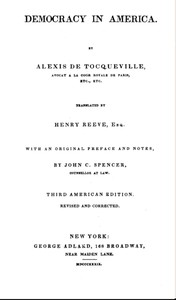
Democracy in America — Volume 2

  • Free to read
  • 9 hours to read
  • 82 chapters
  • Reading level: College-level

"Democracy in America — Volume 2" by Alexis de Tocqueville is a classic work published in 1840. Following his 1831 journey through the United States, Tocqueville examines the democratic revolution transforming Western society. He analyzes American culture through a critical lens, exploring how equality, social mobility, and democratic institutions shape religious, political, and economic life. While praising egalitarian progress, Tocqueville questions the moral and spiritual costs of restless democratic society. This influential work has profoundly shaped Western political thought and social science.

Read free now No app, no sign-up. Your place is saved automatically. Or download for your e-reader ↓
  • United States · Politics and government
  • United States · Social conditions
  • Democracy · United States

Read the opening

Book Two: Influence Of Democracy On Progress Of Opinion In: the United States

De Tocqueville's Preface To The Second Part

The Americans live in a democratic state of society, which has naturally suggested to them certain laws and a certain political character. This same state of society has, moreover, engendered amongst them a multitude of feelings and opinions which were unknown amongst the elder aristocratic communities of Europe: it has destroyed or modified all the relations which before existed, and established others of a novel kind. The—aspect of civil society has been no less affected by these changes than that of the political world. The former subject has been treated of in the work on the Democracy of America, which I published five years ago; to examine the latter is the object of the present book; but these two parts complete each other, and form one and the same work.

I must at once warn the reader against an error which would be extremely prejudicial to me. When he finds that I attribute so many different consequences to the principle of equality, he may thence infer that I consider that principle to be the sole cause of all that takes place in the present age: but this would be to impute to me a very narrow view. A multitude of opinions, feelings, and propensities are now in existence, which owe their origin to circumstances unconnected with or even contrary to the principle of equality. Thus if I were to select the United States as an example, I could easily prove that the nature of the country, the origin of its inhabitants, the religion of its founders, their acquired knowledge, and their former habits, have exercised, and still exercise, independently of democracy, a vast influence upon the thoughts and feelings of that people. Different causes, but no less distinct from the circumstance of the equality of conditions, might be traced in Europe, and would explain a great portion of the occurrences taking place amongst us.

Keep reading Democracy in America — Volume 2 →

Contents

Show all 82 chapters
  1. Book Two: Influence Of Democracy On Progress Of Opinion In: the United States
  2. Book Two: Influence Of Democracy On Progress Of Opinion In: the United States
  3. Chapter I: Philosophical Method Among the Americans
  4. Chapter II: Of The Principal Source Of Belief Among Democratic Nations
  5. Chapter III: Why The Americans Display More Readiness And More Taste For: General Ideas Than Their Forefathers, The English
  6. Chapter IV: Why The Americans Have Never Been So Eager As The French For: General Ideas In Political Matters
  7. Chapter V: Of The Manner In Which Religion In The United States Avails: Itself Of Democratic Tendencies
  8. Chapter VI: Of The Progress Of Roman Catholicism In The United States
  9. Chapter VII: Of The Cause Of A Leaning To Pantheism Amongst Democratic: Nations
  10. Chapter VIII: The Principle Of Equality Suggests To The Americans The: Idea Of The Indefinite Perfectibility Of Man
  11. Chapter IX: The Example Of The Americans Does Not Prove That A: Democratic People Can Have No Aptitude And No Taste For Science, Literature, Or Art
  12. Chapter X: Why The Americans Are More Addicted To Practical Than To: Theoretical Science
  13. Chapter XI: Of The Spirit In Which The Americans Cultivate The Arts
  14. Chapter XII: Why The Americans Raise Some Monuments So Insignificant: And Others So Important
  15. Chapter XIII: Literary Characteristics Of Democratic Ages
  16. Chapter XIV: The Trade Of Literature
  17. Chapter XV: The Study Of Greek And Latin Literature Peculiarly Useful In: Democratic Communities
  18. Chapter XVI: The Effect Of Democracy On Language
  19. Chapter XVII: Of Some Of The Sources Of Poetry Amongst Democratic: Nations
  20. Chapter XVIII: Of The Inflated Style Of American Writers And Orators
  21. Chapter XIX: Some Observations On The Drama Amongst Democratic Nations
  22. Chapter XX: Characteristics Of Historians In Democratic Ages
  23. Chapter XXI: Of Parliamentary Eloquence In The United States
  24. Chapter I: Why Democratic Nations Show A More Ardent And Enduring Love: Of Equality Than Of Liberty
  25. Chapter II: Of Individualism In Democratic Countries
  26. Chapter III: Individualism Stronger At The Close Of A Democratic: Revolution Than At Other Periods
  27. Chapter IV: That The Americans Combat The Effects Of Individualism By: Free Institutions
  28. Chapter V: Of The Use Which The Americans Make Of Public Associations In: Civil Life
  29. Chapter VI: Of The Relation Between Public Associations And Newspapers
  30. Chapter VII: Connection Of Civil And Political Associations
  31. Chapter VIII: The Americans Combat Individualism By The Principle Of: Interest Rightly Understood
  32. Chapter IX: That The Americans Apply The Principle Of Interest Rightly: Understood To Religious Matters
  33. Chapter X: Of The Taste For Physical Well-Being In America
  34. Chapter XI: Peculiar Effects Of The Love Of Physical Gratifications In: Democratic Ages
  35. Chapter XII: Causes Of Fanatical Enthusiasm In Some Americans
  36. Chapter XIII: Causes Of The Restless Spirit Of Americans In The Midst Of: Their Prosperity
  37. Chapter XIV: Taste For Physical Gratifications United In America To Love: Of Freedom And Attention To Public Affairs
  38. Chapter XV: That Religious Belief Sometimes Turns The Thoughts Of The: Americans To Immaterial Pleasures
  39. Chapter XVI: That Excessive Care Of Worldly Welfare May Impair That: Welfare
  40. Chapter XVII: That In Times Marked By Equality Of Conditions And: Sceptical Opinions, It Is Important To Remove To A Distance The Objects Of Human Actions
  41. Chapter XVIII: That Amongst The Americans All Honest Callings Are: Honorable
  42. Chapter XIX: That Almost All The Americans Follow Industrial Callings
  43. Chapter XX: That Aristocracy May Be Engendered By Manufactures
  44. Book Three: Influence Of Democracy On Manners, Properly So Called
  45. Chapter I: That Manners Are Softened As Social Conditions Become More: Equal
  46. Chapter II: That Democracy Renders The Habitual Intercourse Of The: Americans Simple And Easy
  47. Chapter III: Why The Americans Show So Little Sensitiveness In Their Own: Country, And Are So Sensitive In Europe
  48. Chapter IV: Consequences Of The Three Preceding Chapters
  49. Chapter V: How Democracy Affects the Relation Of Masters And Servants
  50. Chapter VI: That Democratic Institutions And Manners Tend To Raise Rents: And Shorten The Terms Of Leases
  51. Chapter VII: Influence Of Democracy On Wages
  52. Chapter VIII: Influence Of Democracy On Kindred
  53. Chapter IX: Education Of Young Women In The United States
  54. Chapter X: The Young Woman In The Character Of A Wife
  55. Chapter XI: That The Equality Of Conditions Contributes To The: Maintenance Of Good Morals In America
  56. Chapter XII: How The Americans Understand The Equality Of The Sexes
  57. Chapter XIII: That The Principle Of Equality Naturally Divides The: Americans Into A Number Of Small Private Circles
  58. Chapter XIV: Some Reflections On American Manners
  59. Chapter XV: Of The Gravity Of The Americans, And Why It Does Not Prevent: Them From Often Committing Inconsiderate Actions
  60. Chapter XVI: Why The National Vanity Of The Americans Is More Restless: And Captious Than That Of The English
  61. Chapter XVII: That The Aspect Of Society In The United States Is At Once: Excited And Monotonous
  62. Chapter XVIII: Of Honor In The United States And In Democratic: Communities
  63. Chapter XIX: Why So Many Ambitious Men And So Little Lofty Ambition Are: To Be Found In The United States
  64. Chapter XX: The Trade Of Place-Hunting In Certain Democratic Countries
  65. Chapter XXI: Why Great Revolutions Will Become More Rare
  66. Chapter XXII: Why Democratic Nations Are Naturally Desirous Of Peace: And Democratic Armies Of War
  67. Chapter XXIII: Which Is The Most Warlike And Most Revolutionary Class In: Democratic Armies?
  68. Chapter XXIV: Causes Which Render Democratic Armies Weaker Than Other: Armies At The Outset Of A Campaign, And More Formidable In Protracted Warfare
  69. Chapter XXV: Of Discipline In Democratic Armies
  70. Chapter XXVI: Some Considerations On War In Democratic Communities
  71. Book Four: Influence Of Democratic Opinions On Political Society
  72. Chapter I: That Equality Naturally Gives Men A Taste For Free: Institutions
  73. Chapter II: That The Notions Of Democratic Nations On Government Are: Naturally Favorable To The Concentration Of Power
  74. Chapter III: That The Sentiments Of Democratic Nations Accord With Their: Opinions In Leading Them To Concentrate Political Power
  75. Chapter IV: Of Certain Peculiar And Accidental Causes Which Either Lead: A People To Complete Centralization Of Government, Or Which Divert Them From It
  76. Chapter V: That Amongst The European Nations Of Our Time The Power Of: Governments Is Increasing, Although The Persons Who Govern Are Less Stable
  77. Chapter VI: What Sort Of Despotism Democratic Nations Have To Fear
  78. Chapter VII: Continuation Of The Preceding Chapters
  79. Chapter VIII: General Survey Of The Subject
  80. Part I: Appendix A
  81. Part II: Appendix G
  82. Part II: Appendix G
  83. Section 1: All legislative Powers herein granted shall be vested in a: Congress of the United States, which shall consist of a Senate and House of Representatives
  84. Section 7: All Bills for Raising Revenue shall originate in the House of: Representatives; but the Senate may propose or concur with Amendments as on other Bills
  85. Section 4: The President, Vice-President and all civil Officers of the: United States, shall be removed from Office on Impeachment for, and Conviction of, Treason, Bribery, or other High Crimes and Misdemeanors
  86. Section 2: Congress shall have power to enforce this article by: appropriate legislation

Download for your e-reader

Files are provided by Project Gutenberg. On a Kindle, the simplest route is to send the EPUB with Amazon’s Send to Kindle. Downloaded copies don’t sync with your place on Classic Book Reader.

About this edition

This free edition of Democracy in America — Volume 2 by Alexis de Tocqueville comes from Project Gutenberg eBook #816, released 2006-01-21. It is in the public domain in the United States, so you can read it here in full at no cost, on any phone, tablet or computer. Genre: History - American, Philosophy & Ethics, Sociology, Politics.

Summary provided by Project Gutenberg (automatically generated).

More by Alexis de Tocqueville