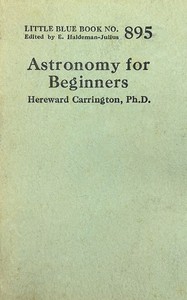
Cover of Astronomy for beginners

Astronomy for beginners

  • Free to read
  • 55 min read
  • 58 chapters

Astronomy for beginners by Hereward Carrington is a compact popular-science primer written in the early 20th century. It offers a clear, accessible introduction to astronomy for lay readers, outlining how the cosmos works and how we study it. The book opens by separating astronomy from astrology, then tours the solar system: the Sun (its layers, spots, and influence), each planet from Mercury to Neptune (with notes on moons, rings, atmospheres, and habitability), the minor planets, and the Moon’s features, phases, and origin. It surveys theories of solar-system formation (from Laplace to the planetesimal hypothesis), maps the sky’s constellations, and explains meteors, meteorites, comets, nebulae, and the Milky Way. Carrington summarizes stellar facts—numbers, distances (light-years), motions, temperatures, and types (fixed, double, colored, variable, temporary), plus star clusters. He describes eclipses, transits, and occultations, and introduces the tools that revolutionized astronomy—telescopes, spectroscopy, and photography. Core physical ideas follow: tides, gravitation, the ether (as then conceived), and atomic analogies; alongside atmospheric and geophysical topics such as lightning, fireballs, magnetism, and the aurora. Practical matters—measuring time and space, the International Date Line, calendars—lead to brief notes on curved space, the darkness and cold of interstellar space, prospects for life beyond Earth, possible causes of ice ages, why stars twinkle, the Moon’s size illusion, and a closing set of concise definitions.

Read free now No app, no sign-up. Your place is saved automatically. Or download for your e-reader ↓
  • Astronomy

Read the opening

Printed in the United States of America

Introductory 5

Astrology 7

The Solar System 8

The Sun 9

Mercury 11

Keep reading Astronomy for beginners →

Contents

Show all 58 chapters
  1. Printed in the United States of America
  2. Introductory
  3. Astrology
  4. The Solar System
  5. The Sun
  6. Mercury
  7. Venus
  8. The Earth
  9. Mars
  10. Jupiter
  11. Saturn
  12. Uranus
  13. Neptune
  14. The Minor Planets
  15. Are There Other Planets?
  16. The Moon
  17. The Origin of the Solar System
  18. Constellations
  19. Meteorites
  20. Comets
  21. Nebulae
  22. The Milky Way
  23. The Number of Stars
  24. The Position of Our Solar System
  25. The Movement of Our Solar System
  26. Distances of the Stars
  27. Temperature of the Stars
  28. Fixed Stars
  29. Double Stars
  30. Colored Stars
  31. Variable Stars
  32. Temporary Stars
  33. Star Groups — Clusters
  34. Eclipses
  35. Telescopes
  36. The Spectroscope: Spectrum Analysis
  37. Photography
  38. The Tides
  39. Gravitation
  40. The Ether
  41. Atomic Analogies
  42. Thunder and Lightning
  43. Fireballs
  44. Atmospheric Electricity
  45. The Earth’s Magnetism
  46. The Aurora Borealis
  47. Time: Measurement of
  48. Space: Measurement of
  49. The International Day Line
  50. Calendars, Etc
  51. The Temperature of Space
  52. Light in Space
  53. Life in Space
  54. The Causes of an Ice Age
  55. Why Does the Moon Sometimes Appear Larger?
  56. Are the Planets Inhabited?
  57. A Few Definitions
  58. Transcriber’s Notes

Download for your e-reader

Files are provided by Project Gutenberg. On a Kindle, the simplest route is to send the EPUB with Amazon’s Send to Kindle. Downloaded copies don’t sync with your place on Classic Book Reader.

About this edition

This free edition of Astronomy for beginners by Hereward Carrington comes from Project Gutenberg eBook #78112, released 2026-03-04. It is in the public domain in the United States, so you can read it here in full at no cost, on any phone, tablet or computer.

Summary provided by Project Gutenberg (automatically generated).

More by Hereward Carrington