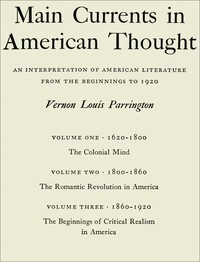
Cover of Main currents in American thought

Main currents in American thought

  • Free to read
  • 37 hours to read
  • 118 chapters

"Main currents in American thought" by Vernon Louis Parrington is a critical history of American literature and ideas written in the early 20th century. The study interprets American writing through the lenses of political, economic, and social change, tracing how European doctrines took root and reshaped themselves in the New World. It centers on the long contest between liberal-democratic impulses and conservative-theocratic or capitalistic systems, with Volume One probing the clash of Puritan theocracy and emerging Yankee individualism in colonial New England. The opening of the work lays out a frankly liberal, Jeffersonian vantage point and explains that the inquiry follows ideas as they evolve through theology, politics, and economics rather than through belletristic schools. The introduction maps the European bequests—English Independency (natural rights), French romantic theory and Physiocracy (equality, agrarianism), and English laissez faire (commercial individualism)—and frames colonial thought as a struggle among figures like Roger Williams, Franklin, and Jefferson on one side and John Cotton, Jonathan Edwards, and Alexander Hamilton on the other. It argues that colonial literature is best understood in its polemics on church and state. Beginning Book One, the narrative shows New England shaped by freehold landholding and a mercantile spirit, producing yeomanry and gentry and the dual ideals of Puritan and Yankee. It then sketches English backgrounds: Puritanism as a middle-class, Reformation-driven movement that fostered natural rights, while Calvinist theology resisted egalitarianism in contrast to Luther’s individualist strain. The transplant to Massachusetts fused Plymouth-style congregational churches with a corporate charter that enabled a theocratic oligarchy, yet freehold property quietly seeded local democracy even as statutes and the Cambridge Platform enforced orthodoxy. Finally, the portrait of John Cotton presents the chief priestly steward of theocracy—an erudite, commanding preacher who, after the Antinomian crisis, backed coercive orthodoxy and a biblically sanctioned, aristocratic state that restricted civic power to the godly.

Read free now No app, no sign-up. Your place is saved automatically. Or download for your e-reader ↓
  • United States · Politics and government
  • United States · Civilization
  • American literature · History and criticism
  • Philosophy, American
  • United States · Religion
  • United States · Intellectual life

Read the opening

Volume Three • 1860-1920: The Beginnings of Critical Realism in America

COPYRIGHT, 1927, 1930, BY
HARCOURT, BRACE AND COMPANY, INC.

_All rights reserved, including
the right to reproduce this book
or portions thereof in any form._

_Omnium Amicus erat
qui
Justiciam ament._

It is with a certain feeling of temerity that I offer the present study of a field of American letters which has been pretty largely neglected. That feeling springs from no sense of the slightness of the materials treated of, or their remoteness from present-day interests. To one who has dwelt for any length of time amidst the polemics of colonial debate, a conviction of the greatness of the issues and the intellectual honesty and masculine vigor of the disputants, comes home with compelling force. The subjects with which they dealt are old-fashioned only in manner and dress; at heart they were much the same themes with which we are engaged, and with which our children will be engaged after us. The feeling springs rather from a sense of the complexity and many-sidedness of the materials, with their ramifications into theology and politics and economics, and with backgrounds that conduct to remote origins in European systems of thought; and it is quickened by the realization that the interpretation here offered, runs in many points counter to that frequently given. The point of view from which I have endeavored to evaluate the materials, is liberal rather than conservative, Jeffersonian rather than Federalistic; and very likely in my search I have found what I went forth to find, as others have discovered what they were seeking. Unfortunately the mens aequa et clara is the rarest of attributes, and dead partisanships have a disconcerting way of coming to life again in the pages of their historians. That the vigorous passions and prejudices of the times I have dealt with may have found an echo in my judgments is, perhaps, to be expected; whether they have distorted my interpretation and vitiated my analysis is not for me to determine.

Keep reading Main currents in American thought →

Contents

Show all 118 chapters
  1. Volume Three • 1860-1920: The Beginnings of Critical Realism in America
  2. Part I: The Puritan Heritage — 1620-1660
  3. Part II: The Twilight of the Oligarchy — 1660-1720
  4. Part I: The Mind in the Making — 1720-1763
  5. Part II: The Awakening of the American Mind — 1763-1783
  6. Part I: The Agrarian Defeat — 1783-1787
  7. Part II: Political Democracy Gets under Way — 1787-1800
  8. Book One • Liberalism and Puritanism
  9. Part One: The Puritan Heritage • 1620-1660
  10. Chapter I • English Backgrounds
  11. Chapter II • The Transplanting of Ideas
  12. Chapter III • The Chief Stewards of Theocracy
  13. Chapter IV • The Contributions of Independency
  14. Chapter V • Other Dreamers in Israel
  15. Part Two: the Twilight of the Oligarchy • 1660-1720
  16. Part Two: the Twilight of the Oligarchy • 1660-1720
  17. Chapter I • Samuel Sewall • Yankee
  18. Chapter II • The Mather Dynasty
  19. Chapter III • Stirrings of Liberalism
  20. Book Two • The Colonial Mind
  21. Part One: The Mind in the Making • 1720-1763
  22. Chapter I • Colonial Backgrounds
  23. Chapter II • The Anachronism of Jonathan Edwards
  24. Chapter III • Benjamin Franklin • Our First Ambassador
  25. Part Two: The Awakening of the American Mind • 1763-1783
  26. Chapter I • Imperial Sovereignty and Home Rule
  27. Chapter II • The Mind of the American Tory
  28. Chapter III • John Dickinson • The Mind of the American Whig
  29. Chapter IV • Samuel Adams • The Mind of the American Democrat
  30. Chapter V • Literary Echoes
  31. Chapter II • The Great Debate
  32. Chapter III • Political Thinkers • The English Group
  33. Part Two: Political Democracy Gets Under Way • 1787-1800
  34. Chapter I • The Impact of the French Revolution
  35. Chapter II • Political Thinkers • The French Group
  36. Chapter III • The War of Belles Lettres
  37. Book I: Part I
  38. Book I: Part II
  39. Book II: Part I
  40. Book II: Part II
  41. Book III: Part I
  42. Book III: Part II
  43. Part I
  44. Part II
  45. Part III
  46. Book II: The Mind of the Middle East
  47. Book III: The Mind of New England
  48. Part I
  49. Part II
  50. Part III
  51. Part IV
  52. Book One • The Mind of the South
  53. Part One: The Virginia Renaissance
  54. Chapter I • The Old Dominion
  55. Chapter II • The Heritage of Jeffersonianism
  56. Chapter III • John Marshall • Last of the Virginia Federalists
  57. Chapter IV • The Older Plantation Mind
  58. Chapter V • Adventures in Romance
  59. Part Two: The Renaissance of Slavery
  60. Chapter I • Southern Imperialism
  61. Chapter II • Winds of Political Doctrine
  62. Chapter III • The Dream of a Greek Democracy
  63. Chapter IV • Adventures in Belles Lettres
  64. Part Three: The Romance of the West
  65. Chapter I • New Worlds
  66. Chapter II • Two Spokesmen of the West
  67. Chapter III • The Frontier in Letters
  68. Book Two • The Mind of the Middle East
  69. Book Two • The Mind of the Middle East
  70. Chapter I • The Old Capital
  71. Chapter II • The New Capital
  72. Chapter III • Two Knickerbocker Romantics
  73. Chapter IV • James Fenimore Cooper • Critic
  74. Chapter V • Some Contributions of New England
  75. Book Three • The Mind of New England
  76. Part One: the Twilight of Federalism
  77. Chapter I • The Passing of the Tie-Wig School
  78. Chapter II • Winds of Political Doctrine
  79. Part Two: The Rise of Liberalism
  80. Chapter I • The Renaissance
  81. Chapter II • Liberalism and Calvinism
  82. Chapter III • Liberalism and the Social Conscience
  83. Chapter IV • Certain Militants
  84. Part Three: The Transcendental Mind
  85. Chapter I • The Genesis of Transcendentalism
  86. Chapter II • Ralph Waldo Emerson • Transcendental Critic
  87. Chapter III • Henry Thoreau • Transcendental Economist
  88. Chapter IV • Theodore Parker • Transcendental Minister
  89. Chapter V • Margaret Fuller • Rebel
  90. Part IV: Other Aspects of the New England Mind
  91. Chapter I • The Reign of the Genteel
  92. Chapter II • Nathaniel Hawthorne • Skeptic
  93. Chapter III • The Authentic Brahmin
  94. Conclusion
  95. Book I: Part I
  96. Book I: Part II
  97. Book I: Part III
  98. Book II
  99. Book III: Part I
  100. Book III: Part II
  101. Book III: Part III
  102. Book III: Part IV
  103. Book III: Part IV
  104. Foreword
  105. Introduction[492]
  106. Book I: Changing America
  107. Part I
  108. Part II
  109. Part I
  110. Part II
  111. Part III
  112. Part I: The Rise of Liberalism[497]
  113. Part II
  114. Part III
  115. Book One • Changing America
  116. Part One: The Gilded Age
  117. Chapter I • the American Scene
  118. Chapter II • The Culture of the Seventies
  119. Chapter III • Changing Theory
  120. Chapter IV • The Beginnings of Criticism
  121. Part Two: New Patterns of Thought
  122. Chapter I • Disintegration and Reintegration
  123. Chapter II • The Skepticism of the House of Adams
  124. Chapter III • Victorian Realism
  125. Book Two • The Old and the New: Storm Clouds
  126. Part One: The Middle Border Rises
  127. Chapter I • The Plight of the Farmer
  128. Chapter II • The Democracy of the Age of Innocence
  129. Chapter III • Literature and the Middle Border[765]
  130. Part Two: Proletarian Hopes[776]
  131. Chapter III • The Quest of Utopia
  132. Chapter IV • The Darkening Skies of Letters
  133. Book I: Part I
  134. Book I: Part II
  135. Book II: Part I
  136. Book II: Part II

Download for your e-reader

Files are provided by Project Gutenberg. On a Kindle, the simplest route is to send the EPUB with Amazon’s Send to Kindle. Downloaded copies don’t sync with your place on Classic Book Reader.

About this edition

This free edition of Main currents in American thought by Vernon Louis Parrington comes from Project Gutenberg eBook #78025, released 2026-02-24. It is in the public domain in the United States, so you can read it here in full at no cost, on any phone, tablet or computer.

Summary provided by Project Gutenberg (automatically generated).