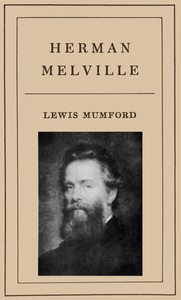
Cover of Herman Melville

Herman Melville

  • Free to read
  • 8 hours to read
  • 70 chapters

Herman Melville is a biography of the American author Herman Melville by Lewis Mumford, first published in 1929. Mumford, who felt a close affinity with Melville, gives both an account of the author's life and an interpretation of his works in the book, devoting particular attention to Moby-Dick and the later works published thereafter. The book played a role in the Melville revival of the 1920s, helping to affirm the author's reputation and to indicate connections between his work and later literature. The book was later republished under the title Herman Melville: A Study of His Life and Vision. (This summary is from Wikipedia.)

Read free now No app, no sign-up. Your place is saved automatically. Or download for your e-reader ↓
  • Novelists, American · 19th century · Biography
  • Melville, Herman, 1819-1891

Read the opening

Prologue

When Herman Melville died in 1891, the literary journal of the day, The Critic, did not even know who he was. The editors rose bravely to the occasion and copied a paragraph about him from a compendium of American literature; and in the weeks that followed they reprinted various commentaries on Melville and his work that were carried in the correspondence columns of the New York newspapers.

The older generation remembered that Herman Melville had once been famous. He had adventured in the South Seas on a whaler; he had lived among the cannibals; and in Typee and Omoo he had made a romantic pastiche of his experiences. On these books Mr. Melville’s fame had been founded: it was a pity he had not done more in this line; for his later books, obscure books, crowded books, books that could be called neither fiction nor poetry nor philosophy nor downright useful information, forfeited the interest of a public that liked to take its pleasures methodically. Both the fame and the later absence of recognition, Mr. Melville’s commentators agreed, were deserved. By his interest in Sir Thomas Browne and metaphysics, Mr. Melville had carried his readers into a realm much too remote, and an air too rarefied: a flirtation with a South Sea maiden, warm, brown, palpable, was one thing: but the shark that glides white through the sulphurous sea was quite another. In Moby-Dick, so criticism went, Melville had become obscure: and this literary failure condemned him to personal obscurity.

Keep reading Herman Melville →

Contents

Show all 70 chapters
  1. Preface
  2. Prologue
  3. Chapter 2
  4. Chapter 3
  5. Chapter 4
  6. Chapter 5
  7. Chapter 6
  8. Chapter 7
  9. Chapter 2
  10. Chapter 3
  11. Chapter 4
  12. Chapter 2
  13. Chapter 3
  14. Chapter 4
  15. Chapter 5
  16. Chapter 6
  17. Chapter 2
  18. Chapter 3
  19. Chapter 4
  20. Chapter 5
  21. Chapter 6
  22. Chapter 2
  23. Chapter 3
  24. Chapter 4
  25. Chapter 2
  26. Chapter 3
  27. Chapter 2
  28. Chapter 3
  29. Chapter 4
  30. Chapter 5
  31. Chapter 6
  32. Chapter 7
  33. Chapter 8
  34. Chapter 9
  35. Chapter 10
  36. Chapter 11
  37. Chapter 2
  38. Chapter 3
  39. Chapter 4
  40. Chapter 5
  41. Chapter 6
  42. Chapter 7
  43. Chapter 2
  44. Chapter 3
  45. Chapter 4
  46. Chapter 5
  47. Chapter 6
  48. Chapter 7
  49. Chapter 8
  50. Chapter 9
  51. Chapter 10
  52. Chapter 2
  53. Chapter 3
  54. Chapter 4
  55. Chapter 5
  56. Chapter 6
  57. Chapter 7
  58. Chapter 2
  59. Chapter 3
  60. Chapter 4
  61. Chapter 5
  62. Chapter 6
  63. Chapter 7
  64. Chapter 8
  65. Chapter 2
  66. Chapter 3
  67. Chapter 4
  68. Chapter 5
  69. Chapter 6
  70. Epilogue

Download for your e-reader

Files are provided by Project Gutenberg. On a Kindle, the simplest route is to send the EPUB with Amazon’s Send to Kindle. Downloaded copies don’t sync with your place on Classic Book Reader.

About this edition

This free edition of Herman Melville by Lewis Mumford comes from Project Gutenberg eBook #78016, released 2026-02-23. It is in the public domain in the United States, so you can read it here in full at no cost, on any phone, tablet or computer.

Summary provided by Project Gutenberg (automatically generated).

More by Lewis Mumford