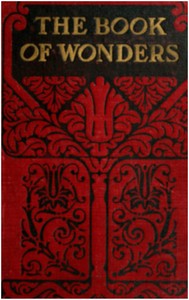
Cover of The book of wonders

The book of wonders

  • Free to read
  • 14 hours to read
  • 75 chapters
  • Reading level: 8th & 9th grade

"The Book of Wonders: Gives Plain and Simple Answers to the Thousands of..." edited by Rudolph J. Bodmer is an illustrated educational compendium written in the early 20th century. This work serves as a wide-ranging reference, offering clear, concise explanations for a vast array of "everyday questions" about science, technology, language, and human inventions. Its evident aim is to stimulate curiosity and provide practical knowledge on how both nature and human ingenuity have shaped the modern world. The book's accessible style and abundance of illustrations make it suitable for curious readers of all ages, especially children and young adults eager to understand the wonders that surround them. The opening of "The Book of Wonders" begins by detailing the book's origins—rooted in a father's efforts to answer his son's questions—and frames the work as a response to the innate curiosity found in children. The first section delves into foundational topics such as the history of writing instruments (from the stylus to the steel pen), how writing and speech developed, and the evolution of language and personal names. Subsequent segments explain practical inquiries like why a pencil writes, how a camera captures images, what causes stars to twinkle, and the origins of tools and weapons. Early chapters also offer engaging narratives about technological progress, from primitive stone-throwing to modern firearms, and provide clear scientific explanations for everyday phenomena—ensuring readers are both informed and inspired to wonder about the world.

Read free now No app, no sign-up. Your place is saved automatically. Or download for your e-reader ↓
  • Encyclopedias and dictionaries
  • Science · Miscellanea
  • Curiosities and wonders
  • Questions and answers
  • Technology · Miscellanea

Read the opening

The Editor

How Man Learned to Write

It is a long time between the day of the cave-dwellers, with their instruments of chipped stone, and the present day of the pen. Yet wide apart as are these points of time, the trend of development can with but few obstacles be traced.

The story of the pen is a natural sequence of ideas between the first piece of rock scratched upon rock by prehistoric man, and the bit of metal which now so smoothly records our thoughts.

There was a time in the unwritten history of man when necessity prompted the invention of weapons, and the minds of these primitive men were concentrated upon this point. But the arts of war did not take up their entire time; some time must have been given to other pursuits. As the mind developed, and as an aid to memory, we find them carving, engraving, incising upon the rocks their hieroglyphics, which took the form of figures of men, habitations, weapons, and the animals of their period.

Keep reading The book of wonders →

Contents

Show all 75 chapters
  1. Introduction
  2. The Editor
  3. The First Imitation of Writing
  4. By Cleveland Moffett
  5. The First American Made Guns
  6. A Visit to a Cartridge Factory
  7. Shot Tower — Tallest Building in Connecticut
  8. A Multiple Switchboard
  9. Alexander Graham Bell’s First Telephone
  10. Wool Sorting
  11. Wool Scouring
  12. Worsted Carding
  13. Combing
  14. Gilling and Making Top After Combing
  15. Weaving and Scouring
  16. English Cap Spinning
  17. Finished Cloth, Ready for the Tailor
  18. Mechanical Cement Mixer
  19. Silkworm Preparing to Form Its Cocoon
  20. Winding Frames — Winding the Silk on Bobbins
  21. Water Stretcher — Making the Silk Thread Smooth
  22. First American Public Flight, Mar 12 1908
  23. Model R, 1910
  24. The Story in a Lump of Sugar
  25. Making the Old Rag Carpet
  26. Weaving a Rug by Machinery
  27. Figure 1
  28. How Tunnels Are Built
  29. Making Lead Buckles — The First Step in Paint Making
  30. Filling the Stack with Lead Buckles
  31. The Story in a Steel Rail
  32. Trampling the Clay
  33. Grinding the Plates
  34. An All-Seeing Eye for the Submarine
  35. The Periscope Top
  36. Showing Tube Handling Cargo in Sunken Ship
  37. Living Quarters Aboard a Submarine
  38. English Blacksmith’s Clock
  39. Independence Hall, Philadelphia
  40. The Beginning of a Steamship
  41. Hand Spinning
  42. Interior of Rope Walk, Plymouth Cordage Co
  43. Four-Strand Compound Laying-Machine
  44. Rehearsing Scene in Studio
  45. Calender Room
  46. Curing Room, First Cure — Pneumatics
  47. Tread Laying Room
  48. Where the Shells Are Separated from the Bean
  49. Mill in Which the Beans Are Roasted
  50. Complete Gearless Traction Elevator Installation
  51. Ringing the Call Box
  52. Modern Morse Instruments
  53. The Pioneers of the First Ocean Cable
  54. The Story in a Railway Locomotive
  55. Working the Wireless in the Army
  56. The Wireless in the Army
  57. Wireless Receiving Station in U. S. Army
  58. A Southern Cotton Field
  59. Bales of Cotton at Cotton Mill
  60. Dulcimer
  61. Spinet
  62. Queen Elizabeth’s Virginal
  63. How a Key Turns a Lock
  64. Face of Cylinder Lock
  65. Interior of Master-Keyed Cylinder Lock
  66. Growing Tobacco Under Cheesecloth
  67. The Development of Comb Honey
  68. The Development of Comb Honey
  69. A Swarm Entering a Hive
  70. Effect of a Sting Near the Eye
  71. French Postillion Boot of the Fifteenth Century
  72. The Beginning of a Shoe
  73. Work Performed by Heeling Machines
  74. Acknowledgment
  75. Index

Download for your e-reader

Files are provided by Project Gutenberg. On a Kindle, the simplest route is to send the EPUB with Amazon’s Send to Kindle. Downloaded copies don’t sync with your place on Classic Book Reader.

About this edition

This free edition of The book of wonders by Rudolph J. Bodmer comes from Project Gutenberg eBook #75948, released 2025-04-24. It is in the public domain in the United States, so you can read it here in full at no cost, on any phone, tablet or computer. Genre: Children & Young Adult Reading, Science - Physics, Science - Chemistry/Biochemistry, Science - Biology, Engineering & Technology, Language & Communication, Encyclopedias/Dictionaries/Reference.

Summary provided by Project Gutenberg (automatically generated).