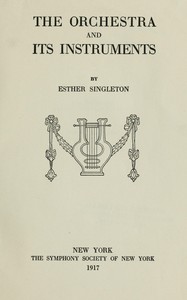
The orchestra and its instruments
by Esther Singleton (1865–1930)
- Free to read
- 6 hours to read
- 12 chapters
- Reading level: 8th & 9th grade
"The Orchestra and Its Instruments" by Esther Singleton is a non-fiction musical guide written in the late 19th century. The book aims to provide music lovers and young students with a deeper understanding of the various instruments that comprise the Symphony Orchestra, detailing their histories and functions within the musical ensemble. With its focus on the orchestra's distinct "personality" formed by the collaboration of different instrumental families, this work serves as an insightful introduction to orchestral music. The opening of the text sets the scene for a concert hall ambiance, inviting readers to observe the arrival of the orchestra and its players. Singleton introduces the primary instrumental families—the strings, woodwinds, brass, and percussion—each assigned its unique role in creating a harmonious ensemble. The narrative emphasizes the individuality of each instrument while illustrating how their collective interplay adds depth and character to orchestral music. It also hints at the enchanting world of music as the conductor prepares to lead the orchestra, striving to engage readers' imaginations and encourage a greater appreciation for this art form.
- Musical instruments
- Orchestra
- Instrumentation and orchestration · History
Read the opening
Chapter I
THE VIOLIN
_Charm of the violin; voice of the violin; parts of the
violin; construction of the violin; bridge, bass-bar and
sound-post; ancestry of the violin; the vielle, or viole;
evolution of the violin; corners and bouts; the sound-holes;
birthplace of the violin; Brescia; Gasparo di Salò; Maggini
and the characteristics of his violins; Efrem Zimbalist’s
Maggini; Cremona; the Amati family and their violins; Antonio
Stradivari; house of Stradivari described by Haweis; the
Stradivari violin; the Guarneri; Joseph del Gesù; Carlo
Bergonzi; Jacobus Stainer of Absam; importance of wood for
violins; Joachim’s opinion of the Stradivari violin; strings of
the violin; the fingerboard and “positions”; harmonics—natural
and artificial; portamento; the sordino; the right hand’s work;
bowing; pizzicato; position of violins in the Orchestra; the
First Violin; Lavignac on the violin; Berlioz on use of violins
in the Orchestra; François Tourte, the Stradivari of the
bow; evolution of the bow; Corelli, Tartini, Tourte, Viotti,
Paganini; Tourte’s model; the bow of to-day._
Keep reading The orchestra and its instruments →
Download for your e-reader
Files are provided by Project Gutenberg. On a Kindle, the simplest route is to send the EPUB with Amazon’s Send to Kindle. Downloaded copies don’t sync with your place on Classic Book Reader.
About this edition
This free edition of The orchestra and its instruments by Esther Singleton comes from Project Gutenberg eBook #73991, released 2024-07-08. It is in the public domain in the United States, so you can read it here in full at no cost, on any phone, tablet or computer. Genre: Music.
Summary provided by Project Gutenberg (automatically generated).