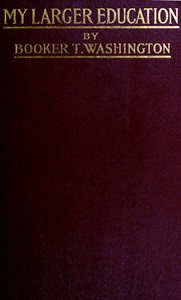
My larger education
by Booker T. Washington (1856–1915)
- Free to read
- 5 hours to read
- 13 chapters
- Reading level: 8th & 9th grade
"My Larger Education: Being Chapters from My Experience" by Booker T. Washington is a collection of essays and reflections written in the early 20th century. This work delves into Washington's personal experiences and insights gained throughout his life as an educator and leader of the African American community, particularly during the post-Civil War era. The likely topic of the book centers around the challenges and opportunities that arose from his background as a former slave and how these shaped his educational philosophies and initiatives, especially in relation to the establishment of the Tuskegee Institute. At the start of the book, Washington reflects on the complexities of his identity and the challenges he faced due to his race and socioeconomic status. He discusses the idea that perceived disadvantages can actually serve as catalysts for growth and resilience. Washington shares lessons learned from his interactions with various people, underscoring the importance of learning directly from life experiences and human relationships rather than solely from books. He illustrates his educational journey and the foundational role that his early experiences, values, and interactions with influential figures played in shaping his approach to education and community uplift. The beginning underscores a philosophy of harnessing adversity as a means to propel personal and collective progress.
- Washington, Booker T., 1856-1915
- African Americans · Biography
- Educators · United States · Biography
Read the opening
Chapter I: Learning from Men and Things
It has been my fortune to be associated all my life with a problem—a hard, perplexing, but important problem. There was a time when I looked upon this fact as a great misfortune. It seemed to me a great hardship that I was born poor, and it seemed an even greater hardship that I should have been born a Negro. I did not like to admit, even to myself, that I felt this way about the matter, because it seemed to me an indication of weakness and cowardice for any man to complain about the condition he was born to. Later I came to the conclusion that it was not only weak and cowardly, but that it was a mistake to think of the matter in the way in which I had done. I came to see that, along with his disadvantages, the Negro in America had some advantages, and I made up my mind that opportunities that had been denied him from without could be more than made up by greater concentration and power within.
Keep reading My larger education →
Download for your e-reader
Files are provided by Project Gutenberg. On a Kindle, the simplest route is to send the EPUB with Amazon’s Send to Kindle. Downloaded copies don’t sync with your place on Classic Book Reader.
About this edition
This free edition of My larger education by Booker T. Washington comes from Project Gutenberg eBook #73923, released 2024-06-27. It is in the public domain in the United States, so you can read it here in full at no cost, on any phone, tablet or computer. Genre: Biographies, Essays, Letters & Speeches, American Literature.
Summary provided by Project Gutenberg (automatically generated).
More by Booker T. Washington