A scrap of paper
by Emile Joseph Dillon (1855–1933)
- Free to read
- 4 hours to read
- 13 chapters
- Reading level: 10th to 12th grade
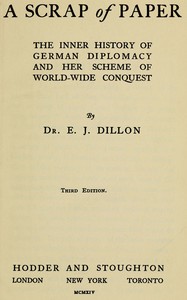
"A Scrap of Paper: The Inner History of German Diplomacy and Her Scheme of World-Wide Conquest" by Dr. E. J. Dillon is a historical account written in the early 20th century. This work delves into the intricacies of German diplomacy, primarily during the lead-up to World War I, and critiques the aggressive ambitions of Germany, emphasizing the devaluation of treaties as mere "scraps of paper.” The book provides an analysis of the ideological and militaristic assumptions driving Germany's actions, portraying a nation fervently pursuing expansion at the expense of its neighbors and international agreements. The opening of the book discusses the profound implications of the phrase "a scrap of paper," as articulated by the German Chancellor, regarding treaties such as that protecting Belgian neutrality. Dillon presents a stark contrast between the ideals of civilized society and the brutal force of militarism which he claims the Prussian leadership endorses. He argues that Germany's ambition is not only territorial but also cultural, seeking to impose its values on other nations through conquest. By examining Germany’s diplomatic maneuvers and the miscalculations of other European powers, Dillon sets the stage to reveal how a premeditated plan for dominance culminated in widespread conflict. He critiques both the British and their own naive assumptions regarding German intentions, trying to awaken his audience to the dangers posed by the German Empire's aggressive policies.
- World War, 1914-1918
- Germany · Foreign relations
Read the opening
Chapter I
THE CAREFULLY LAID SCHEME
Europe’s tremendous tragedy, the opening scenes of which are now unfolding themselves to horrified humanity, is no ordinary conflict arising out of a diplomatic quarrel which timely concessions and soft words might have settled with finality. In its present issues it is the result of a carefully laid scheme of which the leaders of the German people are the playwrights and the Kaiser the chief actor. It was cleverly thought out and patiently prepared. The manifold forces let loose by the Berlin Government for the purpose of leading up to a coup de théâtre which involves the existence of cultured Europe had long since got beyond the control even of those who were employing them. All that was still possible was the choice of the moment for ringing up the curtain and striking the first fell blow. And, sooth to say, judging by the data in the hands of the Berlin Foreign Office, no conjuncture could have been more propitious to Germany’s designs than the present. For circumstance had realized most of the desired conditions, and the Kaiser, without hesitating, availed himself of his good fortune. It is useless to dissemble the fact that the copious information accumulated in the Wilhelmstrasse warranted the belief that there could not have been a more auspicious moment for the realization of the first part of the Kaiser’s programme than the present. If Germany be indeed set apart by Providence as the people chosen to rule Europe and sway the world, the outcome of the present conflict should be to sanction this inscrutable decree of Fate. Certainly the hour has struck for which she has been waiting and keeping her powder dry during the past forty years. It is now or never.
Keep reading A scrap of paper →
Download for your e-reader
Files are provided by Project Gutenberg. On a Kindle, the simplest route is to send the EPUB with Amazon’s Send to Kindle. Downloaded copies don’t sync with your place on Classic Book Reader.
About this edition
This free edition of A scrap of paper by Emile Joseph Dillon comes from Project Gutenberg eBook #72164, released 2023-11-18. It is in the public domain in the United States, so you can read it here in full at no cost, on any phone, tablet or computer. Genre: History - European, History - Modern (1750+), History - Warfare.
Summary provided by Project Gutenberg (automatically generated).
More by Emile Joseph Dillon