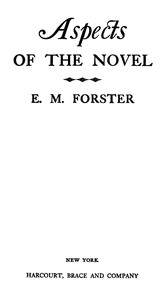
Cover of Aspects of the novel

Aspects of the novel

  • Free to read
  • 3 hours to read
  • 9 chapters
  • Reading level: 8th & 9th grade

"Aspects of the Novel" by E. M. Forster is a literary critique written in the early 20th century. This work compiles a series of lectures that delves into the various elements that constitute the novel, exploring aspects like story, characters, plot, and the rhythm of narration. Forster aims to clarify the complexities of the novel form, providing insights that will resonate with both readers and writers, and discusses the nuances that define successful storytelling. The opening of "Aspects of the Novel" establishes its framework, introducing the author's intention to explore the novel through a mix of humor and intellectual insights. Forster begins by reflecting on the essence of storytelling and its fundamental importance to the structure of novels. He hints at the included discussions about influential authors and offers a critique of both the nature of characters and the role of the reader's interpretation. The initial chapters aim to break down traditional notions of literary analysis, contrasting the narrative qualities of classic and contemporary works, and setting the stage for nuanced examinations of various writing styles and techniques within the realm of fiction.

Read free now No app, no sign-up. Your place is saved automatically. Or download for your e-reader ↓
  • Fiction · Technique
  • English fiction · History and criticism
Read the opening

Chapter I

INTRODUCTORY

THIS lectureship is connected with the name of William George Clark, a fellow of Trinity. It is through him we meet today, and through him we shall approach our subject.

Clark was, I believe, a Yorkshireman. He was born in 1821, was at school at Sedbergh and Shrewsbury, entered Trinity as an undergraduate in 1840, became fellow four years later, and made the college his home for nearly thirty years, only leaving it when his health broke, shortly before his death. He is best known as a Shakespearian scholar, but he published two books on other subjects to which we must here refer. He went as a young man to Spain and wrote a pleasant lively account of his holiday called Gazpacho: Gazpacho being the name of a certain cold soup which he ate and appears to have enjoyed among the peasants of Andalusia: indeed he appears to have enjoyed everything. Eight years later, as a result of a holiday in Greece, he published a second book, Peloponnesus. Peloponnesus is a graver work and a duller. Greece was a serious place in those days, more serious than Spain, besides, Clark had by now not only taken Orders but become Public Orator, and he was, above all, travelling with Dr. Thompson, the then Master of the college, who was not at all the sort of person to be involved in a cold soup. The jests about mules and fleas are consequently few, and we are increasingly confronted with the remains of Classical Antiquity and the sites of battles. What survives in the book—apart from its learning—is its feeling for Greek country-side. Clark also travelled in Italy and Poland.

Keep reading Aspects of the novel →

Contents

  1. Chapter I
  2. Chapter II
  3. Chapter III
  4. Chapter IV: PEOPLE (continued)
  5. Chapter V
  6. Chapter VI
  7. Chapter VII
  8. Chapter VIII
  9. Conclusion

Download for your e-reader

Files are provided by Project Gutenberg. On a Kindle, the simplest route is to send the EPUB with Amazon’s Send to Kindle. Downloaded copies don’t sync with your place on Classic Book Reader.

About this edition

This free edition of Aspects of the novel by E. M. Forster comes from Project Gutenberg eBook #70492, released 2023-04-07. It is in the public domain in the United States, so you can read it here in full at no cost, on any phone, tablet or computer. Genre: Essays, Letters & Speeches, Journalism/Media/Writing.

Summary provided by Project Gutenberg (automatically generated).

More by E. M. Forster