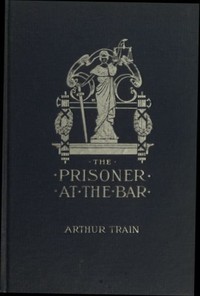
Cover of The Prisoner at the Bar: Sidelights on the Administration of Criminal Justice

The Prisoner at the Bar: Sidelights on the Administration of Criminal Justice

  • Free to read
  • 8 hours to read
  • 20 chapters
  • Reading level: 10th to 12th grade

"The Prisoner at the Bar: Sidelights on the Administration of Criminal Justice" by Arthur Train is a nonfiction account written in the early 20th century. The book aims to provide a detailed and engaging exploration of the criminal justice system, highlighting the processes from arrest to conviction and examining the perspectives of the various participants, including the police, lawyers, and the accused. At the start of this work, Train introduces the complexities surrounding the concept of crime, emphasizing that public perception is often shaped by sensational media coverage rather than an understanding of the legal processes involved. He argues that many commonly held beliefs about crime and criminals are oversimplified or erroneous, and he seeks to provide clarity on the administration of criminal justice. The opening discusses the definition of a crime and highlights the intricacies of legal terminology, illustrating differences between various types of crimes and their implications. Train sets the stage for a comprehensive discussion on how individuals can be categorized as criminals and the societal implications of such classifications.

Read free now No app, no sign-up. Your place is saved automatically. Or download for your e-reader ↓
  • Crime · United States
  • Criminal justice, Administration of · United States
Read the opening

Chapter I

WHAT IS CRIME?

A crime is any act or omission to act punishable as such by law. It is difficult, if not impossible, to devise any closer definition. Speaking broadly, crimes are certain acts, usually wrongful, which are regarded as sufficiently dangerous or harmful to society to be forbidden under pain of punishment. The general relation of crimes to wrongs as a whole is sometimes illustrated by a circle having two much smaller circles within it. The outer circle represents wrongful acts in the aggregate; the second, wrongful acts held by law to be torts, that is to say, infractions of private rights for which redress may be sought in the civil courts, and the smallest or inner circle, acts held to be so injurious to the public as to be punishable as crimes.

This does well enough for the purpose of illustrating the relative proportion of crimes to torts or wrongful acts in general, and, if a tiny dot be placed in the centre of the bull's-eye to represent those crimes which are actually punished, one gets an excellent idea of how infinitely small a number of these serve to keep the whole social fabric in order and sustain the majesty of the law. But the inference might naturally be drawn that whatever was a crime must also be a tort or at least a wrong, which, while true in the majority of instances, is not necessarily the case in all. In a certain sense crimes are always wrongs or, at least, wrong, but only in the sense of being infractions of law are they always wrongs or wrong.

Keep reading The Prisoner at the Bar: Sidelights on the Administration of Criminal Justice →

Contents

  1. Front Matter
  2. Chapter I
  3. Section 2: Any failure to comply with the provisions of this Act: shall be punished by a fine not to exceed one hundred dollars, or imprisonment not to exceed six months, or both
  4. Chapter II
  5. Chapter III
  6. Chapter IV
  7. Chapter V
  8. Chapter VI
  9. Chapter VII
  10. Chapter VIII
  11. Chapter IX
  12. Chapter X
  13. Chapter XI
  14. Chapter XII
  15. Chapter XIII
  16. Chapter XIV
  17. Chapter XV
  18. Chapter XVI
  19. Chapter XVII
  20. Chapter XVIII

Download for your e-reader

Files are provided by Project Gutenberg. On a Kindle, the simplest route is to send the EPUB with Amazon’s Send to Kindle. Downloaded copies don’t sync with your place on Classic Book Reader.

About this edition

This free edition of The Prisoner at the Bar: Sidelights on the Administration of Criminal Justice by Arthur Cheney Train comes from Project Gutenberg eBook #58534, released 2018-12-26. It is in the public domain in the United States, so you can read it here in full at no cost, on any phone, tablet or computer. Genre: Law & Criminology.

Summary provided by Project Gutenberg (automatically generated).

More by Arthur Cheney Train