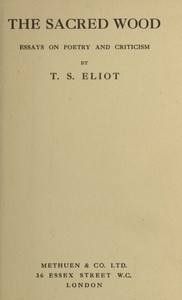
Cover of The Sacred Wood: Essays on Poetry and Criticism

The Sacred Wood: Essays on Poetry and Criticism

  • Free to read
  • 3 hours to read
  • 10 chapters
  • Reading level: 10th to 12th grade

"The Sacred Wood: Essays on Poetry and Criticism" by T. S. Eliot is a collection of literary essays written in the early 20th century. The work explores various aspects of poetry and criticism, reflecting Eliot's thoughts on the evolution of literary practices and the roles of the poet and critic in society. It discusses the importance of tradition, the relationship between old and new works, and the proper function of criticism within literature. The opening portion introduces Eliot’s perspective on literary criticism through a reflection on Matthew Arnold and the Romantic Generation. He critiques the overemphasis of personal sentiment in criticism and the tendency of critics to stray from the essential task of comprehending literature itself. Eliot articulates his belief that true criticism should involve a historical awareness, recognizing the influence of past works on contemporary literature. He emphasizes the necessity to engage with the entire literary tradition, arguing that a poet’s value is inherently tied to their understanding of and relationship with both contemporary and historical texts. This sets the stage for a deeper investigation into the nature of poetic expression and the critic's role in articulating and preserving the art form.

Read free now No app, no sign-up. Your place is saved automatically. Or download for your e-reader ↓
  • Literature
  • Criticism

Read the opening

Chapter I

“Eriger en lois ses impressions personnelles, c’est le grand effort
d’un homme s’il est sincère.”—Lettres à l’Amazone.

Coleridge was perhaps the greatest of English critics, and in a sense the last. After Coleridge we have Matthew Arnold; but Arnold—I think it will be conceded—was rather a propagandist for criticism than a critic, a popularizer rather than a creator of ideas. So long as this island remains an island (and we are no nearer the Continent than were Arnold’s contemporaries) the work of Arnold will be important; it is still a bridge across the Channel, and it will always have been good sense. Since Arnold’s attempt to correct his countrymen, English criticism has followed two directions. When a distinguished critic observed recently, in a newspaper article, that “poetry is the most highly organized form of intellectual activity,” we were conscious that we were reading neither Coleridge nor Arnold. Not only have the words “organized” and “activity,” occurring together in this phrase, that familiar vague suggestion of the scientific vocabulary which is characteristic of modern writing, but one asked questions which Coleridge and Arnold would not have permitted one to ask. How is it, for instance, that poetry is more “highly organized” than astronomy, physics, or pure mathematics, which we imagine to be, in relation to the scientist who practises them, “intellectual activity” of a pretty highly organized type? “Mere strings of words,” our critic continues with felicity and truth, “flung like dabs of paint across a blank canvas, may awaken surprise ... but have no significance whatever in the history of literature.” The phrases by which Arnold is best known may be inadequate, they may assemble more doubts than they dispel, but they usually have some meaning. And if a phrase like “the most highly organized form of intellectual activity” is the highest organization of thought of which contemporary criticism, in a distinguished representative, is capable, then, we conclude, modern criticism is degenerate.

Keep reading The Sacred Wood: Essays on Poetry and Criticism →

Contents

  1. Introduction
  2. Chapter I
  3. Chapter II
  4. Chapter I
  5. Chapter II
  6. Chapter III: ὁ δὲ νοῦς ἴσως θειότερόν τι καὶ ἀπαθές ἐστιν
  7. Chapter I
  8. Chapter II
  9. Chapter I
  10. Chapter II

Download for your e-reader

Files are provided by Project Gutenberg. On a Kindle, the simplest route is to send the EPUB with Amazon’s Send to Kindle. Downloaded copies don’t sync with your place on Classic Book Reader.

About this edition

This free edition of The Sacred Wood: Essays on Poetry and Criticism by T. S. Eliot comes from Project Gutenberg eBook #57795, released 2018-08-28. It is in the public domain in the United States, so you can read it here in full at no cost, on any phone, tablet or computer. Genre: Literature - Other, Essays, Letters & Speeches.

Summary provided by Project Gutenberg (automatically generated).

More by T. S. Eliot