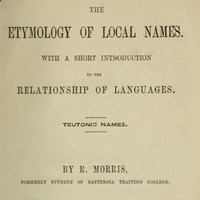
The Etymology of Local Names
by Richard Morris (1833–1894)
- Free to read
- 55 min read
- 8 chapters
- Reading level: 10th to 12th grade
"The Etymology of Local Names" by Richard Morris is a scholarly work that delves into the origins and meanings of place names, likely written in the late 19th century. The book focuses on the historical significance of geographical names and how they reflect the cultures and languages of the peoples who named them. Through exploring both Teutonic and English examples, it aims to reveal the connections between language, history, and local identity. The opening portion introduces the core premise of the text, which is that place names often carry inherent meanings tied to their natural surroundings and historical contexts. Morris discusses how the names bestowed upon various locales provide insights into the linguistic and cultural heritage of their namers, often linked to migrations and settlements over time. He highlights the importance of understanding the etymology of these names, asserting that they are critical to comprehending the geography and history of nations. Various sections are outlined to follow, indicating a comprehensive exploration of local names derived from descriptive elements, tribes, natural features, and other associations relevant to their origins.
- Onomastics
- Names, Geographical · England
- English language · Etymology · Names
Read the opening
Teutonic Names
BY R. MORRIS,
FORMERLY STUDENT OF BATTERSEA TRAINING COLLEGE.
Names have all some meaning when first imposed; and when
a place is named for the first time, by any people, they
apply to it some term—in early times generally descriptive
of its natural peculiarities, or something else, on account
of which it is remarkable, from their own language. When
we find therefore, that the old names of natural objects
and localities in a country belong, for the most part, to a
particular language, we may conclude with certainty that a
people speaking that language formerly occupied the country.
Of this the names they have so impressed are as sure a proof
as if they had left a distinct record of their existence in
words engraven on the rocks. Such old names of places often
long outlive both the people that bestowed them, and nearly
all the material monuments of their occupancy. The language,
as a vehicle of oral communication, may gradually be forgotten
and be heard no more where it was once in universal use,
and the old topographical nomenclature may still remain
unchanged.—Pictorial History of England.
Keep reading The Etymology of Local Names →
Download for your e-reader
Files are provided by Project Gutenberg. On a Kindle, the simplest route is to send the EPUB with Amazon’s Send to Kindle. Downloaded copies don’t sync with your place on Classic Book Reader.
About this edition
This free edition of The Etymology of Local Names by Richard Morris comes from Project Gutenberg eBook #57658, released 2018-08-08. It is in the public domain in the United States, so you can read it here in full at no cost, on any phone, tablet or computer. Genre: History - Other, Language & Communication.
Summary provided by Project Gutenberg (automatically generated).