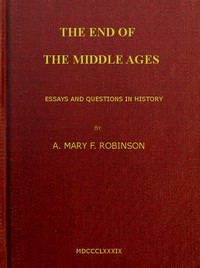
Cover of The End of the Middle Ages: Essays and Questions in History

The End of the Middle Ages: Essays and Questions in History

  • Free to read
  • 7 hours to read
  • 63 chapters
  • Reading level: 8th & 9th grade

"The End of the Middle Ages: Essays and Questions in History" by A. Mary F. Robinson is a historical account written in the late 19th century. The book consists of a series of essays and explorations into various historical topics, specifically focusing on the transitions and the lingering effects of the medieval period. It delves into the dynamics of society at the cusp of modernity, scrutinizing figures, events, and movements that contributed to the decline of the Middle Ages. At the start of the narrative, the author dedicates the volume to Mr. Symonds, reflecting on the profound impact of collaborative historical inquiry. She recounts her journey of discovery, inspired by the timeless figures of the past while acknowledging the complexities inherent in separating medieval history from our contemporary context. This opening sets the stage for an exploration of medieval institutions, social dynamics, and cultural shifts, particularly as seen through the lens of movements such as the Beguines and the Weaving Brothers, which embodied a mix of piety, social responsibility, and heretical undercurrents within the religious landscape. The author raises thought-provoking questions about the end of the Middle Ages and whether it truly marked a definitive transition or if its influences continue to resonate today.

Read free now No app, no sign-up. Your place is saved automatically. Or download for your e-reader ↓
  • Mysticism · History · Middle Ages, 600-1500
  • Italy · History · 1268-1492
  • Milan (Italy) · History
  • Gertrude, the Great, Saint, 1256-1302
  • Visconti, Valentine, duchesse d' Orléans, 1366-1408
  • Malatesta family
  • Medici, Piero di Lorenzo de', 1472-1503
  • Beguines

Read the opening

Chapter I

With the approach of the thirteenth century, the world awoke from its long and dreamless sleep. Then began the age of faith, the miraculous century, starving for lack of bread and nourished upon heavenly roses. St. Louis and St. Elizabeth, Dominic the eloquent and the fiery Bonaventura, Thomas Aquinas and Francis the glorioso poverello di Dio, proclaim the enthusiastic spirit of the age. It is an age of chivalry no less in religion than in love, an age whose somewhat strained and mystical conception of virtue is sweetened by a new strong impulse of human pity. The world begins to see; and the green growth of the earth, the birds of the air, the fishes of the sea, become clear and noticeable things in the eyes of the saints. The world awakes and feels. Jean de Matha and Félix de Valois, gentlemen of Meaux, visit the prisons of France, and redeem many hundred captives from Morocco. On all sides men begin to love the sick, the poor, the sinful; even to long for sickness and poverty, as if in themselves they were virtuous; even to wonder whether sin and evil may not be a holy means for mortifying spiritual pride. To rescue the captive, to feed the hungry, to nurse the leper, as unawares Elizabeth of Hungary tended Christ in her Thuringian city—this is the new ideal of mankind. And this age of feeling is no less an age of speculation, of metaphysical inquiry, of manifold heresies and schisms. No new Bernard stops with his earnest dogma the thousand theories which everywhere arise and spread.

Keep reading The End of the Middle Ages: Essays and Questions in History →

Contents

Show all 63 chapters
  1. Front Matter
  2. Chapter I
  3. Chapter II
  4. Chapter III
  5. Chapter IV
  6. Chapter V
  7. Chapter VI
  8. Chapter VII
  9. Chapter VIII
  10. Chapter IX
  11. Chapter X
  12. Chapter XI
  13. Chapter I
  14. Chapter II
  15. Chapter III
  16. Chapter IV
  17. Chapter V
  18. Chapter VI
  19. Chapter VII
  20. Chapter I
  21. Chapter II
  22. Chapter III
  23. Chapter IV
  24. Chapter V
  25. Chapter VI
  26. Chapter VII
  27. Chapter VIII
  28. Chapter I
  29. Chapter II
  30. Chapter III
  31. Chapter IV
  32. Chapter V
  33. Chapter VI
  34. Chapter VII
  35. Chapter VIII
  36. Chapter IX
  37. Chapter X
  38. Chapter XI
  39. Chapter XII
  40. Chapter XIII
  41. Chapter I
  42. Chapter II
  43. Chapter III
  44. Chapter IV
  45. Chapter V
  46. Chapter VI
  47. Chapter VII
  48. Chapter VIII
  49. Chapter IX
  50. Chapter X
  51. Chapter XI
  52. Chapter II: “Empoli, 26 Oct., 1494
  53. Chapter III
  54. Chapter IV
  55. Chapter V
  56. Chapter I
  57. Chapter II
  58. Chapter III
  59. Chapter III
  60. Chapter IV
  61. Chapter V
  62. Chapter VI
  63. Chapter VII

Download for your e-reader

Files are provided by Project Gutenberg. On a Kindle, the simplest route is to send the EPUB with Amazon’s Send to Kindle. Downloaded copies don’t sync with your place on Classic Book Reader.

About this edition

This free edition of The End of the Middle Ages: Essays and Questions in History by A. Mary F. Robinson comes from Project Gutenberg eBook #53475, released 2016-11-07. It is in the public domain in the United States, so you can read it here in full at no cost, on any phone, tablet or computer. Genre: Essays, Letters & Speeches, History - Medieval/Middle Ages, History - Early Modern (c. 1450-1750).

Summary provided by Project Gutenberg (automatically generated).

More by A. Mary F. Robinson