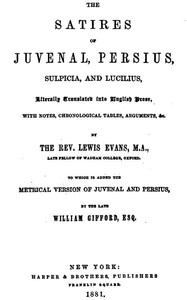
Cover of The Satires of Juvenal, Persius, Sulpicia, and Lucilius

The Satires of Juvenal, Persius, Sulpicia, and Lucilius

  • Free to read
  • 16 hours to read
  • 35 chapters
  • Reading level: 8th & 9th grade

"The Satires of Juvenal, Persius, Sulpicia, and Lucilius" by Juvenal et al. is a classic collection of Roman satirical poetry written in the late 1st century AD to early 2nd century AD. This work features the sharp and critical voices of notable Roman satirists, with Juvenal being one of the most prominent, addressing the societal issues of his time, including corruption, moral decay, and the vices of the elite. The collection serves as both a historical reflection and a literary exploration of human folly and societal shortcomings. The opening of this compilation introduces various contexts, including the life and works of Juvenal, revealing his journey as a poet during the oppressive reign of Emperor Domitian. It highlights how his experiences, particularly his exile, influenced his biting style and themes centered on tyranny and hypocrisy. The preface emphasizes the lack of faithful prose translations prior to this one and sets the stage for the accompanying metrical versions of Juvenal and Persius. The translator expresses a deep admiration for the original poets and a desire to convey their literary spirit, offering insights and critiques that will guide readers through the often complex and layered verses that follow.

Read free now No app, no sign-up. Your place is saved automatically. Or download for your e-reader ↓
  • Verse satire, Latin · Translations into English
  • Juvenal · Translations into English

Read the opening

Book I.[1599]

To the first book there is said to have been annexed an Epistle
to L. Ælius Stilo, the friend of the poet, to whom in all
probability this book was dedicated. (Fr. 16.) We know from a
note of Servius on the tenth book of the Æneid (l. 104), that
the subject was a council of gods held to deliberate on the
fortune of the Roman state; the result of the conference being
that nothing but the death of certain obnoxious individuals
could possibly rescue the city from plunging headlong to ruin.
It is a kind of parody on the council of Celestials held in
the first book of the Odyssey, to discuss the propriety of the
return of Ulysses to Greece: and as Homer represents Neptune, the
great enemy of Ulysses, to have been absent from the meeting,
so here (Fr. 2) we find an allusion to some previous council,
at which Jupiter, by the machinations of Juno (Fr. 15), was
not present. Virgil, as Servius says, borrowed the idea of his
discussion between Venus, Juno, and Jupiter from this book; only
he translated the language of Lucilius into a type more suited
to the dignity of Heroic verse. Lucilius's council begin with
discussing the affairs of mankind at large, and then proceed to
consider the best method of prolonging the Roman state (Fr. 5),
which has no greater enemies than its own corrupt and licentious
morals, and the wide-spreading evils of avarice and luxury. But
amid the growing vices which undermined the state must especially
be reckoned the study of a spurious kind of philosophy, of
rhetoric, and logic, which not only was the cause of universal
indolence and neglect of all serious duties, but also led men
to lay snares to entrap their neighbors. (Fr. inc. 2.) A fair
instance of these sophistical absurdities is given (Fr. inc.
12); and the doctrine of the Stoics, to which Horace alludes
(i. Sat., iii., 124), is also ridiculed. (Fr. inc. 23.) The
pernicious effects of gold are then described, as destructive of
all honesty, good faith, and every religious principle (Fr. inc.
39-47); the result of which is, that the state is fast sinking
into helpless ruin. (Fr. inc. 50.) Nor are the evils of luxury
less baleful. (Fr. 19-21.)

Keep reading The Satires of Juvenal, Persius, Sulpicia, and Lucilius →

Contents

Show all 35 chapters
  1. Front Matter
  2. Introduction
  3. Book I.[1599]
  4. Book II
  5. Book III
  6. Book IV
  7. Book V
  8. Book VI
  9. Book VI
  10. Chapter 12: 13 Three beds stretched on ropes, by Deucalion.[1691]
  11. Book VII
  12. Book VII
  13. Chapter 18: 19 ... We murmur, are ground, sink down....[1711]
  14. Book VIII
  15. Book IX
  16. Book X
  17. Book XI
  18. Book XI
  19. Chapter 4
  20. Book XII
  21. Book XIII
  22. Book XIV
  23. Book XV
  24. Book XVI
  25. Book XVII
  26. Book XVIII
  27. Book XIX
  28. Book XX
  29. Book XXII
  30. Book XXIII
  31. Book XXVI
  32. Book XXVI
  33. Chapter 10
  34. Book XXVII
  35. Book XXVII
  36. Chapter 37
  37. Book XXVIII
  38. Book XXIX
  39. Book XXX
  40. Book XXX
  41. Prologue

Download for your e-reader

Files are provided by Project Gutenberg. On a Kindle, the simplest route is to send the EPUB with Amazon’s Send to Kindle. Downloaded copies don’t sync with your place on Classic Book Reader.

About this edition

This free edition of The Satires of Juvenal, Persius, Sulpicia, and Lucilius by Juvenal et al. comes from Project Gutenberg eBook #50657, released 2015-12-10. It is in the public domain in the United States, so you can read it here in full at no cost, on any phone, tablet or computer. Genre: Poetry, Classics of Literature.

Summary provided by Project Gutenberg (automatically generated).