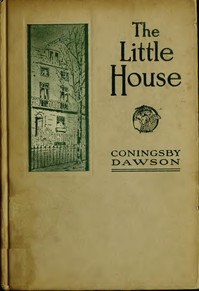
Cover of The Little House

The Little House

  • Free to read
  • 1 hour to read
  • 11 chapters
  • Reading level: 6th grade

"The Little House" by Coningsby Dawson is a novel written in the early 20th century, specifically around the time of World War I. This imaginative tale is centered on a house in London that serves as the narrator, recounting the story of its inhabitants and the events that unfold within its walls during a tumultuous period marked by air raids and personal struggles. The narrative explores themes of love, loss, and the search for belonging amidst a backdrop of war. The story primarily follows the experiences of a lonely widow, referred to as the little lady, and her two children, Robbie and Joan, who seek refuge in the little house during an air raid. Pathetic yet resilient, she becomes intertwined with an American officer who, having recently returned from the front, finds solace in her company. Their encounter blossoms into a deep connection, marked by shared vulnerabilities and the yearning for companionship. As they navigate their turbulent emotions against the realities of war, the little house witnesses their journey towards healing and hope, ultimately leading to a poignant and uplifting conclusion that emphasizes the power of love and human connection in difficult times.

Read free now No app, no sign-up. Your place is saved automatically. Or download for your e-reader ↓
  • Christmas stories
  • World War, 1914-1918
  • Love stories
  • Widows
  • Soldiers

Read the opening

Chapter I

HE little house, tell this story. It was lived within my walls; not a line is invented and it was I, by my interfering, who brought about the happy ending. Who wants a story that does not end happily, especially a Christmas story? To have been responsible for the happy ending is pretty nearly as clever as to have made the story up out of one's own head or, as we houses say, out of one's own walls.

Perhaps you never heard before of a house telling a story. If that be so, it is because you don't listen or because you go to bed too early. Unlike people, we houses sleep all day long; but after midnight we wake up and talk. When the clock strikes twelve, our stairs begin to crack and our windows to rattle and our floors to creak. If you ever hear these sounds, don't be frightened; they simply mean that the kind old walls that shelter you have begun to remember and to think. And we have so many things to remember and to think about, especially we old houses who have been standing for almost two hundred years. We have seen so much; we have been the friends of so many generations. More little children have been born beneath our roofs than we have stairs on which to count. We reckon things on our stairs, just as people reckon things on their fingers. When our stairs crack after midnight, it's usually because we're counting' the births and love-makings and marriages we have watched. We very often get them wrong because there are so many of them. Then the doors and windows and floors will chip in to correct us. “Ha,” a window will rattle, “you've forgotten the little girl who used to gaze through my panes in 1760 or thereabouts.” One of the doors will swing slowly on its hinges and, if anyone disputes with it, will bang, shouting angrily, “Wrong again—all wrong.” Then the walls and the windows and the doors and the floors all start whispering, trying to add up correctly the joys and sorrows they have witnessed in the years beyond recall.

Keep reading The Little House →

Contents

  1. Chapter I
  2. Chapter II
  3. Chapter III
  4. Chapter IV
  5. Chapter V
  6. Chapter VI
  7. Chapter VII
  8. Chapter VIII
  9. Chapter IX
  10. Chapter X
  11. Chapter XI

Download for your e-reader

Files are provided by Project Gutenberg. On a Kindle, the simplest route is to send the EPUB with Amazon’s Send to Kindle. Downloaded copies don’t sync with your place on Classic Book Reader.

About this edition

This free edition of The Little House by Coningsby Dawson comes from Project Gutenberg eBook #50274, released 2015-10-21. It is in the public domain in the United States, so you can read it here in full at no cost, on any phone, tablet or computer. Genre: Novels, British Literature.

Summary provided by Project Gutenberg (automatically generated).

More by Coningsby Dawson