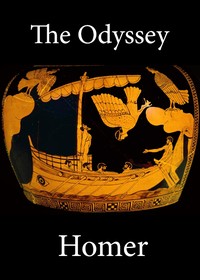
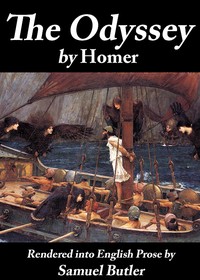
Cover of The Odysseys of Homer, together with the shorter poems

The Odysseys of Homer, together with the shorter poems

  • Free to read
  • 12 hours to read
  • 66 chapters
  • Reading level: 7th grade

"The Odysseys of Homer" by Homer is an epic poem, believed to have been composed in the 8th century BC. This classic work recounts the adventures of the hero Odysseus, who faces numerous trials and tribulations as he attempts to return home to Ithaca following the Trojan War. Central to the narrative is the theme of loyalty, persistence, and the quest for identity as Odysseus seeks to reunite with his wife, Penelope, and reclaim his home from the suitors who have invaded it. The opening of the poem introduces the council of gods who discuss Odysseus's plight, with Athena advocating for him as he remains trapped on the island of Calypso. Upon hearing of his father's misfortunes, Telemachus, Odysseus's son, is stirred to action and resolves to seek news of his father. Athena visits him in disguise to guide him on his quest, providing both support and insight as he prepares to journey towards Pylos and Sparta in search of information about Odysseus. This initial section sets the stage for Telemachus's growth and impending adventure, establishing the bond between father and son while also highlighting the influence of the gods in human affairs.

Read free now No app, no sign-up. Your place is saved automatically. Or download for your e-reader ↓
  • Epic poetry, Greek · Translations into English
  • Odysseus, King of Ithaca (Mythological character)
Read the opening

Chapman’s Introduction

I have adventured, right noble Earl, out of my utmost and ever-vowed service to your virtues, to entitle their merits to the patronage of Homer’s English life, whose wished natural life the great Macedon would have protected as the spirit of his empire,

That he to his unmeasur’d mighty acts Might add a fame as vast; and their extracts, In fires as bright and endless as the stars, His breast might breathe and thunder out his wars. But that great monarch’s love of fame and praise Receives an envious cloud in our foul days; For since our great ones ceased themselves to do, Deeds worth their praise, they hold it folly too To feed their praise in others. But what can, Of all the gifts that are, be giv’n to man More precious than Eternity and Glory, Singing their praises in unsilenc’d story? Which no black day, no nation, nor no age, No change of time or fortune, force nor rage, Shall ever rase? All which the monarch knew, Where Homer liv’d entitled, would ensue: Cuius de gurgite vivo Combibit arcanos vatum omnis turba furores, etc. From whose deep fount of life the thirsty rout Of Thespian prophets have lien sucking out Their sacred rages. And as th’ influent stone Of Father Jove’s great and laborious son Lifts high the heavy iron, and far implies The wide orbs that the needle rectifies, In virtuous guide of ev’ry sea-driv’n course, To all aspiring his one boundless force; So from one Homer all the holy fire That ever did the hidden heat inspire In each true Muse came clearly sparkling down, And must for him compose one flaming crown. He, at Jove’s table set, fills out to us Cups that repair age sad and ruinous, And gives it built of an eternal stand With his all-sinewy Odyssæan hand, Shifts time and fate, puts death in life’s free state, And life doth into ages propagate. He doth in men the Gods’ affects inflame, His fuel Virtue blown by Praise and Fame; And, with the high soul’s first impression driv’n, Breaks through rude chaos, earth, the seas, and heav’n. The nerves of all things hid in nature lie Naked before him; all their harmony Tun’d to his accents, that in beasts breathe minds. What fowls, what floods, what earth, what air, what winds, What fires ethereal, what the Gods conclude In all their counsels, his Muse makes indued With varied voices that ev’n rocks have mov’d. And yet for all this, naked Virtue lov’d, Honours without her he as abject prizes, And foolish Fame, deriv’d from thence, despises. When from the vulgar taking glorious bound Up to the mountain where the Muse is crown’d, He sits and laughs to see the jaded rabble Toil to his hard heights, t’ all access unable, etc.

Keep reading The Odysseys of Homer, together with the shorter poems →

Contents

Show all 66 chapters
  1. Front Matter
  2. Chapman’s Introduction
  3. Another
  4. The Argument
  5. Another Argument
  6. Finis Libri Primi Hom. Odyss
  7. The Argument
  8. Another Argument
  9. The Argument
  10. Another Argument
  11. The Argument
  12. Another Argument
  13. Finis Libri Quarti Hom. Odyss
  14. The Argument
  15. Another Argument
  16. Finis Libri Quinti Hom. Odyss
  17. The Argument
  18. Another Argument
  19. Finis Libri Sexti Hom. Odyss
  20. The Argument
  21. Another Argument
  22. Finis Libri Septimi Hom. Odyss
  23. The Argument
  24. Another Argument
  25. Finis Libri Octavi Hom. Odyss
  26. The Argument
  27. Another Argument
  28. Finis Libri Noni Hom. Odyss
  29. The Argument
  30. Another Argument
  31. Finis Decimi Libri Hom. Odyss
  32. The Argument
  33. Another Argument
  34. Finis Libri Undecimi Hom. Odyss
  35. The Argument
  36. Another Argument
  37. Finis Duodecimi Libri Hom. Odyss
  38. The Argument
  39. Another Argument
  40. The End of the Thirteenth Book of Homer’s Odysseys
  41. The End of the Fourteenth Book of Homer’s Odysseys
  42. The Argument
  43. Another Argument
  44. The End of the Fifteenth Book of Homer’s Odysseys
  45. The Argument
  46. Another Argument
  47. The End of the Sixteenth Book of Homer’s Odysseys
  48. The Argument
  49. Another Argument
  50. The End of the Seventeenth Book of Homer’s Odysseys
  51. Another Argument
  52. The Argument
  53. Another Argument
  54. The End of the Nineteenth Book of Homer’s Odysseys
  55. Another Argument
  56. Another Argument
  57. The Epistle Dedicatory
  58. The Occasion of This Imposed Crowne
  59. Batrachomyomachia
  60. The End of Homer’s Battle of Frogs and Mice
  61. Hymns
  62. The End of the Hymn to Apollo
  63. The End of the Hymn to Hermes
  64. The End of the First Hymn to Venus
  65. Epigrams and Other Poems
  66. The End of All the Endless Works of Homer

Download for your e-reader

Files are provided by Project Gutenberg. On a Kindle, the simplest route is to send the EPUB with Amazon’s Send to Kindle. Downloaded copies don’t sync with your place on Classic Book Reader.

About this edition

This free edition of The Odysseys of Homer, together with the shorter poems by Homer comes from Project Gutenberg eBook #48895, released 2015-05-08. It is in the public domain in the United States, so you can read it here in full at no cost, on any phone, tablet or computer. Genre: Mythology, Legends & Folklore, Classics of Literature.

Summary provided by Project Gutenberg (automatically generated).

More by Homer