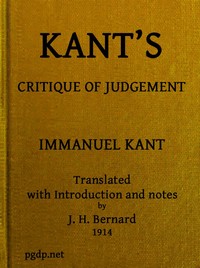
Cover of Kant's Critique of Judgement

Kant's Critique of Judgement

  • Free to read
  • 9 hours to read
  • 15 chapters
  • Reading level: College-level

"Kant's Critique of Judgement" by Immanuel Kant is a philosophical work published in 1790. The third in Kant's critical trilogy, it bridges his earlier investigations of knowledge and morality by exploring the nature of judgment itself. Divided into aesthetic and teleological sections, the work examines how we make judgments about beauty, the sublime, and purpose in nature. Kant introduces the concept of "subjective universal" judgments, revealing how aesthetic experiences claim validity beyond personal preference while resisting absolute determination.

Read free now No app, no sign-up. Your place is saved automatically. Or download for your e-reader ↓
  • Judgment (Logic)
  • Judgment (Aesthetics)
  • Teleology

Read the opening

I. Of the Division of Philosophy

We proceed quite correctly if, as usual, we divide Philosophy, as containing the principles of the rational cognition of things by means of concepts (not merely, as logic does, principles of the form of thought in general without distinction of Objects), into theoretical and practical. But then the concepts, which furnish their Object to the principles of this rational cognition, must be specifically distinct; otherwise they would not justify a division, which always presupposes a contrast between the principles of the rational cognition belonging to the different parts of a science.

Now there are only two kinds of concepts, and these admit as many distinct principles of the possibility of their objects, viz. natural concepts and the concept of freedom. The former render possible theoretical cognition according to principles a priori; the latter in respect of this theoretical cognition only supplies in itself a negative principle (that of mere contrast), but on the other hand it furnishes fundamental propositions which extend the sphere of the determination of the will and are therefore called practical. Thus Philosophy is correctly divided into two parts, quite distinct in their principles; the theoretical part or Natural Philosophy, and the practical part or Moral Philosophy (for that is the name given to the practical legislation of Reason in accordance with the concept of freedom). But up to the present a gross misuse of these expressions has prevailed, both in the division of the different principles and consequently also of Philosophy itself. For what is practical according to natural concepts has been identified with the practical according to the concept of freedom; and so with the like titles, ‘theoretical’ and ‘practical’ Philosophy, a division has been made, by which in fact nothing has been divided (for both parts might in such case have principles of the same kind).
Keep reading Kant's Critique of Judgement →

Contents

  1. Front Matter
  2. Preface
  3. I. Of the Division of Philosophy
  4. II. Of the Realm of Philosophy in General
  5. III. Of the Critique of Judgement As a Means of Combining the Two Parts: Of Philosophy into a Whole
  6. IV. Of Judgement As a Faculty Legislating a Priori
  7. V. The Principle of the Formal Purposiveness of Nature Is a: Transcendental Principle of Judgement
  8. VI. Of the Combination of the Feeling of Pleasure with the Concept of: The Purposiveness of Nature
  9. VII. Of the Aesthetical Representation of the Purposiveness of Nature
  10. VIII. Of the Logical Representation of the Purposiveness of Nature
  11. IX. Of the Connexion of the Legislation of Understanding with That of: Reason by Means of the Judgement
  12. First Book
  13. Second Book
  14. Second Book
  15. Appendix
  16. Part II

Download for your e-reader

Files are provided by Project Gutenberg. On a Kindle, the simplest route is to send the EPUB with Amazon’s Send to Kindle. Downloaded copies don’t sync with your place on Classic Book Reader.

About this edition

This free edition of Kant's Critique of Judgement by Immanuel Kant comes from Project Gutenberg eBook #48433, released 2015-03-08. It is in the public domain in the United States, so you can read it here in full at no cost, on any phone, tablet or computer. Genre: Philosophy & Ethics.

Summary provided by Project Gutenberg (automatically generated).

More by Immanuel Kant