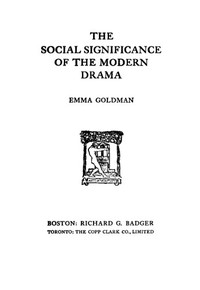
Cover of The Social Significance of the Modern Drama

The Social Significance of the Modern Drama

  • Free to read
  • 5 hours to read
  • 45 chapters
  • Reading level: 7th grade

"The Social Significance of the Modern Drama" by Emma Goldman is a treatise published in 1914. Drawing on her extensive work with Modernist dramatists, Goldman analyzes the political and radical implications of major playwrights from the late nineteenth and early twentieth centuries. The book examines works by Henrik Ibsen, August Strindberg, George Bernard Shaw, Anton Chekhov, and many others, revealing how modern drama could awaken radical consciousness. Goldman published this work to introduce both radicals and ordinary citizens to theater's transformative potential.

Read free now No app, no sign-up. Your place is saved automatically. Or download for your e-reader ↓
  • European drama · History and criticism
  • Drama · Social aspects

Read the opening

Henrik Ibsen

In a letter to George Brandes, shortly after the Paris Commune, Henrik Ibsen wrote concerning the State and political liberty:

"The State is the curse of the individual. How has the national strength of Prussia been purchased? By the sinking of the individual in a political and geographical formula.... The State must go! That will be a revolution which will find me on its side. Undermine the idea of the State, set up in its place spontaneous action, and the idea that spiritual relationship is the only thing that makes for unity, and you will start the elements of a liberty which will be something worth possessing."

The State was not the only bête noire of Henrik Ibsen. Every other institution which, like the State, rests upon a lie, was an iniquity to him. Uncompromising demolisher of all false idols and dynamiter of all social shams and hypocrisy, Ibsen consistently strove to uproot every stone of our social structure. Above all did he thunder his fiery indictment against the four cardinal sins of modern society: the Lie inherent in our social arrangements; Sacrifice and Duty, the twin curses that fetter the spirit of man; the narrow-mindedness and pettiness of Provincialism, that stifles all growth; and the Lack of Joy and Purpose in Work which turns life into a vale of misery and tears.

Keep reading The Social Significance of the Modern Drama →

Contents

Show all 45 chapters
  1. Foreword
  2. Henrik Ibsen
  3. The Pillars of Society
  4. A Doll's House
  5. Ghosts
  6. An Enemy of Society
  7. Strindberg
  8. The Father
  9. Countess Julie
  10. Comrades
  11. Hermann Sudermann
  12. Magda
  13. The Fires of St. John
  14. Lonely Lives
  15. The Weavers
  16. The Sunken Bell
  17. The Awakening of Spring
  18. Maeterlinck
  19. Chantecler
  20. Damaged Goods
  21. Maternity
  22. George Bernard Shaw
  23. Mrs. Warren's Profession
  24. Major Barbara
  25. John Galsworthy
  26. Strife
  27. Justice
  28. The Pigeon
  29. Hindle Wakes
  30. Rutherford and Son
  31. William Butler Yeats
  32. Where There Is Nothing
  33. Harvest
  34. Maurice Harte
  35. The Russian Drama
  36. Tolstoy
  37. The Power of Darkness
  38. Anton Tchekhof
  39. The Seagull
  40. The Cherry Orchard
  41. A Night's Lodging
  42. King-Hunger
  43. Works by Peter Kropotkin
  44. Miscellaneous
  45. Mother Earth

Download for your e-reader

Files are provided by Project Gutenberg. On a Kindle, the simplest route is to send the EPUB with Amazon’s Send to Kindle. Downloaded copies don’t sync with your place on Classic Book Reader.

About this edition

This free edition of The Social Significance of the Modern Drama by Emma Goldman comes from Project Gutenberg eBook #43490, released 2013-08-17. It is in the public domain in the United States, so you can read it here in full at no cost, on any phone, tablet or computer. Genre: Plays/Films/Dramas, Essays, Letters & Speeches, Sociology.

Summary provided by Project Gutenberg (automatically generated).

More by Emma Goldman