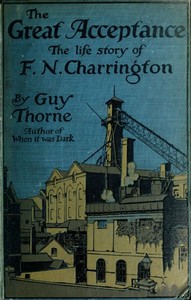
Cover of The Great Acceptance: The Life Story of F. N. Charrington

The Great Acceptance: The Life Story of F. N. Charrington

  • Free to read
  • 5 hours to read
  • 10 chapters
  • Reading level: 8th & 9th grade

"The Great Acceptance: The Life Story of F. N. Charrington" by Guy Thorne is a historical account written in the early 20th century. The book chronicles the life and transformative work of Frederick Nicholas Charrington, a wealthy British brewer who devoted his life to various charitable efforts in London's East End, particularly focusing on temperance and helping the impoverished. The text provides insight into his motivations and the social conditions of the time that influenced his decisions. At the start of the biography, the author introduces Charrington and the East End of London—depicted as a neglected area in dire need of attention. The narrative outlines Charrington's early life, including his privileged upbringing and education, before detailing a pivotal moment when he witnesses domestic violence connected to alcohol abuse at a public house bearing his family's name. This shocking event leads him to reject his inheritance and dedicate himself to a life of service, ultimately becoming a significant figure in the temperance movement. The opening sets the stage for a deeper exploration of his humanitarian efforts and their impacts on the community he served.

Read free now No app, no sign-up. Your place is saved automatically. Or download for your e-reader ↓
  • Poor · England · London
  • Charrington, Fredk. N. (Frederick Nicholas), 1850-1936

Read the opening

Chapter I

THE GREAT ACCEPTANCE

In the year 1882 the most popular novelist of his day wrote as follows about the East End of London—

"Two millions of people, or thereabouts, live in the East
End of London. That seems a good-sized population for an
utterly unknown town. They have no institutions of their own
to speak of, no public buildings of any importance, no
municipality, no gentry, no carriages, no soldiers, no
picture-galleries, no theatres, no opera,—they have
nothing. It is the fashion to believe they are all paupers,
which is a foolish and mischievous belief, as we shall
presently see. Probably there is no such spectacle in the
whole world as that of this immense, neglected, forgotten
great city of East London. It is even neglected by its own
citizens, who have never yet perceived their abandoned
condition. They are Londoners, it is true, but they have no
part or share in London; its wealth, its splendours, its
honours, exist not for them. They see nothing of any
splendours; even the Lord Mayor's Show goeth westward: the
City lies between them and the greatness of England. They
are beyond the wards, and cannot become aldermen; the rich
London merchants go north and south and west; but they go
not east. Nobody goes east, no one wants to see the place;
no one is curious about the way of life in the east. Books
on London pass it over; it has little or no history; great
men are not buried in its churchyards, which are not even
ancient, and crowded by citizens as obscure as those who now
breathe the upper air about them. If anything happens in the
east, people at the other end have to stop and think before
they can remember where the place may be."

Keep reading The Great Acceptance: The Life Story of F. N. Charrington →

Contents

  1. Front Matter
  2. Chapter I
  3. Chapter II
  4. Chapter III
  5. Chapter IV
  6. Chapter V
  7. Chapter VI
  8. Chapter VII
  9. Chapter VIII
  10. Chapter IX

Download for your e-reader

Files are provided by Project Gutenberg. On a Kindle, the simplest route is to send the EPUB with Amazon’s Send to Kindle. Downloaded copies don’t sync with your place on Classic Book Reader.

About this edition

This free edition of The Great Acceptance: The Life Story of F. N. Charrington by Guy Thorne comes from Project Gutenberg eBook #39999, released 2012-06-15. It is in the public domain in the United States, so you can read it here in full at no cost, on any phone, tablet or computer. Genre: Biographies, History - British.

Summary provided by Project Gutenberg (automatically generated).

More by Guy Thorne