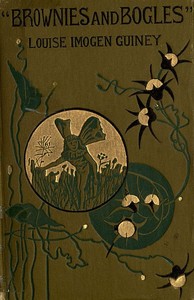
Cover of Brownies and Bogles

Brownies and Bogles

  • Free to read
  • 2 hours to read
  • 12 chapters
  • Reading level: 7th grade

"Brownies and Bogles" by Louise Imogen Guiney is a whimsical collection of folklore and fairy tales written in the late 19th century. The book explores the enchanting world of fairies, brownies, and bogles, delving into their characteristics and the roles they play in human life. At its core, it features a discussion on various types of fairy creatures, focusing particularly on Brownies who assist humans with household tasks, and their mischievous counterparts, the bogles. At the start of the narrative, the author defines fairies, contrasting modern interpretations with more romanticized historical views. Guiney introduces the idea of fairies being once revered as noble characters and calls upon various folkloric beliefs to illustrate the complexity of fairy lore. She reflects on how these beings have been perceived across different cultures, enlightening readers on the playful and sometimes troublesome nature of these enchanted creatures. The opening portion sets a vibrant tone, inviting readers into a magical realm filled with fascinating lore while hinting at the joy and mischief that these fairies can bring to both mortals and their own kind.

Read free now No app, no sign-up. Your place is saved automatically. Or download for your e-reader ↓
  • Fantasy literature
  • Conduct of life
  • Children · Conduct of life
  • Fairies
  • Goblins
  • Trolls
  • Elves
  • Mermaids

Read the opening

Chapter I

WHAT FAIRIES WERE AND WHAT THEY DID.

A FAIRY is a humorous person sadly out of fashion at present, who has had, nevertheless, in the actors' phrase, a long and prosperous run on this planet. When we speak of fairies nowadays, we think only of small sprites who live in a kingdom of their own, with manners, laws, and privileges very different from ours. But there was a time when "fairy" suggested also the knights and ladies of romance, about whom fine spirited tales were told when the world was younger. Spenser's Faery Queen, for instance, deals with dream-people, beautiful and brave, as do the old stories of Arthur and Roland; people who either never lived, or who, having lived, were glorified and magnified by tradition out of all kinship with common men. Our fairies are fairies in the modern sense. We will make it a rule, from the beginning, that they must be small, and we will put out any who are above the regulation height. Such as the charming famous Melusina, who wails upon her tower at the death of a Lusignan, we may as well skip; for she is a tall young lady, with a serpent's tail, to boot, and thus, alas! half-monster; for if we should accept any like her in our plan, there is no reason why we should not get confused among mermaids and dryads, and perhaps end by scoring down great Juno herself as a fairy! Many a dwarf and goblin, whom we shall meet anon, is as big as a child. Again, there are rumors in nearly every country of finding hundreds of them on a square inch of oak-leaf, or beneath the thin shadow of a blade of grass. The fairies of popular belief are little and somewhat shrivelled, and quite as apt to be malignant as to be frolicsome and gentle. We shall find that they were divided into several classes and families; but there is much analogy and vagueness among these divisions. By and by you may care to study them for yourselves; at present, we shall be very high-handed with the science of folk-lore, and pay no attention whatever to learned gentlemen, who quarrel so foolishly about these things that it is not helpful, nor even funny, to listen to them. A widely-spread notion is that when our crusading forefathers went to the Holy Land, they heard the Paynim soldiers, whom they fought, speaking much of the Peri, the loveliest beings imaginable, who dwelt in the East. Now, the Arabian language, which these swarthy warriors used, has no letter P, and therefore they called their spirits Feri, as did the Crusaders after them; and the word went back with them to Europe, and slipped into general use.

Keep reading Brownies and Bogles →

Contents

  1. Chapter I
  2. Chapter II
  3. Chapter III
  4. Chapter IV
  5. Chapter V
  6. Chapter VI
  7. Chapter VII
  8. Chapter VIII
  9. Chapter IX
  10. Chapter X
  11. Chapter XI
  12. Chapter XII

Download for your e-reader

Files are provided by Project Gutenberg. On a Kindle, the simplest route is to send the EPUB with Amazon’s Send to Kindle. Downloaded copies don’t sync with your place on Classic Book Reader.

About this edition

This free edition of Brownies and Bogles by Louise Imogen Guiney comes from Project Gutenberg eBook #39782, released 2012-05-24. It is in the public domain in the United States, so you can read it here in full at no cost, on any phone, tablet or computer. Genre: Mythology, Legends & Folklore.

Summary provided by Project Gutenberg (automatically generated).

More by Louise Imogen Guiney