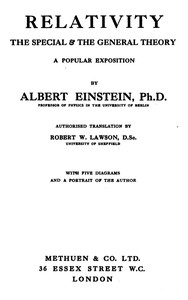
Cover of Relativity: The Special and General Theory

Relativity: The Special and General Theory

  • Free to read
  • 2 hours to read
  • 33 chapters
  • Reading level: College-level

"Relativity: The Special and General Theory" by Albert Einstein is a popular science book published in German in 1916. Einstein wrote it to explain his revolutionary theories of relativity to readers without advanced mathematical training. The book explores special relativity, general relativity, and cosmology through thought experiments involving trains, light rays, and moving observers. It demonstrates how fundamental concepts like time, simultaneity, and mass-energy are not absolute but depend on one's frame of reference, challenging centuries of assumptions about the nature of space and time.

Read free now No app, no sign-up. Your place is saved automatically. Or download for your e-reader ↓
  • Relativity (Physics)

Read the opening

Chapter I: Physical Meaning of Geometrical Propositions

In your schooldays most of you who read this book made acquaintance with the noble building of Euclid’s geometry, and you remember—perhaps with more respect than love—the magnificent structure, on the lofty staircase of which you were chased about for uncounted hours by conscientious teachers. By reason of our past experience, you would certainly regard everyone with disdain who should pronounce even the most out-of-the-way proposition of this science to be untrue. But perhaps this feeling of proud certainty would leave you immediately if some one were to ask you: “What, then, do you mean by the assertion that these propositions are true?” Let us proceed to give this question a little consideration.

Geometry sets out from certain conceptions such as “plane,” “point,” and “straight line,” with which we are able to associate more or less definite ideas, and from certain simple propositions (axioms) which, in virtue of these ideas, we are inclined to accept as “true.” Then, on the basis of a logical process, the justification of which we feel ourselves compelled to admit, all remaining propositions are shown to follow from those axioms, i.e. they are proven. A proposition is then correct (“true”) when it has been derived in the recognised manner from the axioms. The question of “truth” of the individual geometrical propositions is thus reduced to one of the “truth” of the axioms. Now it has long been known that the last question is not only unanswerable by the methods of geometry, but that it is in itself entirely without meaning. We cannot ask whether it is true that only one straight line goes through two points. We can only say that Euclidean geometry deals with things called “straight lines,” to each of which is ascribed the property of being uniquely determined by two points situated on it. The concept “true” does not tally with the assertions of pure geometry, because by the word “true” we are eventually in the habit of designating always the correspondence with a “real” object; geometry, however, is not concerned with the relation of the ideas involved in it to objects of experience, but only with the logical connection of these ideas among themselves.

Keep reading Relativity: The Special and General Theory →

Contents

Show all 33 chapters
  1. Front Matter
  2. Preface
  3. Part I: The Special Theory of Relativity
  4. Chapter I: Physical Meaning of Geometrical Propositions
  5. Chapter II: The System of Co-Ordinates
  6. Chapter III
  7. Chapter V: The Principle of Relativity (in the Restricted Sense)
  8. Chapter VI
  9. Chapter VII
  10. Chapter VIII
  11. Chapter IX
  12. Chapter X
  13. Chapter XI
  14. Chapter XII
  15. Chapter XIII: Theorem of the Addition of Velocities. The Experiment of Fizeau
  16. Chapter XIV
  17. Chapter XV
  18. Chapter XVI
  19. Chapter XVII
  20. Part II: The General Theory of Relativity
  21. Chapter XVIII
  22. Chapter XIX
  23. Chapter XX
  24. Chapter XXI
  25. Chapter XXII
  26. Chapter XXIII: Behaviour of Clocks and Measuring-Rods on a Rotating Body of Reference
  27. Chapter XXIV
  28. Chapter XXV
  29. Chapter XXVI
  30. Chapter XXVII
  31. Chapter XXVIII
  32. Chapter XXIX
  33. Part III: Considerations on the Universe As a Whole
  34. Chapter XXX
  35. Chapter XXXI: The Possibility of a “Finite” and Yet “Unbounded” Universe
  36. Chapter XXXII: The Structure of Space According to the General Theory of Relativity

Download for your e-reader

Files are provided by Project Gutenberg. On a Kindle, the simplest route is to send the EPUB with Amazon’s Send to Kindle. Downloaded copies don’t sync with your place on Classic Book Reader.

About this edition

This free edition of Relativity: The Special and General Theory by Albert Einstein comes from Project Gutenberg eBook #30155, released 2009-10-01. It is in the public domain in the United States, so you can read it here in full at no cost, on any phone, tablet or computer. Genre: Science - Physics.

Other editions: eBook #5001.

Summary provided by Project Gutenberg (automatically generated).

More by Albert Einstein