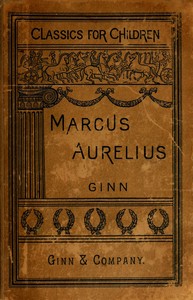
Cover of Meditations

Meditations

  • Free to read
  • 5 hours to read
  • 6 chapters
  • Reading level: 8th & 9th grade

"Meditations" by Emperor of Rome Marcus Aurelius is a series of personal writings composed between 170-180 CE. Written in Greek as private notes to himself, this work captures the Roman Emperor's reflections on Stoic philosophy and self-improvement during military campaigns. Never intended for publication, these intimate musings explore finding one's place in the universe, maintaining ethical principles, and achieving inner harmony through reason. The twelve books reveal how one of history's most powerful rulers sought to guide his own character and judgment.

Read free now No app, no sign-up. Your place is saved automatically. Or download for your e-reader ↓
  • Stoics
  • Ethics
  • Life

Read the opening

Appendix

CORRESPONDENCE OF M. AURELIUS ANTONINUS AND M. CORNELIUS FRONTO[1]

M. CORNELIUS FRONTO was a Roman by descent, but of provincial birth, being native to Cirta, in Numidia. Thence he migrated to Rome in the reign of Hadrian, and became the most famous rhetorician of his day. As a pleader and orator he was counted by his contemporaries hardly inferior to Tully himself, and as a teacher his aid was sought for the noblest youths of Rome. To him was entrusted the education of M.

Aurelius and of his colleague L. Verus in their boyhood; and he was rewarded for his efforts by a seat in the Senate and the consular rank (A.D. 143). By the exercise of his profession he became wealthy; and if he speaks of his means as not great,[2] he must be comparing his wealth with the grandees of Rome, not with the ordinary citizen.

Before the present century nothing was known of the works of Fronto, except a grammatical treatise; but in 1815 Cardinal Mai published a number of letters and some short essays of Fronto, which he had discovered in a palimpsest at Milan. Other parts of the same MS. he found later in the Vatican, the whole being collected

Keep reading Meditations →

Contents

  1. Introduction
  2. Appendix
  3. Book II "Both to frequent" (4). Gr. τὸ μή, C. conjectures τὸ μὲ. The: text is probably right: "I did not frequent public lectures, and I was taught at home."
  4. Book IV Xv. "Agathos" (18): This is probably not a proper name, but the: text seems to be unsound. The meaning may be "the good man ought"
  5. Book VII Ix. C. translates his conjecture mh for h. The Greek means: "straight, or rectified," with a play on the literal and metaphorical meaning of ortoz
  6. Book X Xxii. The Greek means, "paltry breath bearing up corpses, so that: the tale of Dead Man's Land is clearer."

Download for your e-reader

Files are provided by Project Gutenberg. On a Kindle, the simplest route is to send the EPUB with Amazon’s Send to Kindle. Downloaded copies don’t sync with your place on Classic Book Reader.

About this edition

This free edition of Meditations by Marcus Aurelius comes from Project Gutenberg eBook #2680, released 2001-06-01. It is in the public domain in the United States, so you can read it here in full at no cost, on any phone, tablet or computer. Genre: Biographies, Classics of Literature, Philosophy & Ethics.

Summary provided by Project Gutenberg (automatically generated).

More by Marcus Aurelius