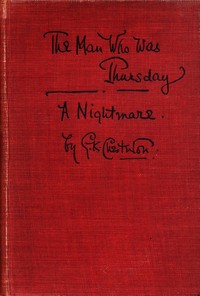
The Man Who Was Thursday: A Nightmare
by G. K. Chesterton (1874–1936)
- Free to read
- 4 hours to read
- 16 chapters
- Reading level: 6th grade
"The Man Who Was Thursday: A Nightmare" by G. K. Chesterton is a philosophical novel with elements of adventure and satire, written in the late 19th century. The story revolves around the enigmatic character Gabriel Syme, a police detective who infiltrates a group of anarchists in London to uncover their plans and identities. As the narrative unfolds, it explores complex themes of order, chaos, and the nature of evil, often through witty dialogue and absurd situations that challenge conventional thinking. At the start of the novel, readers are introduced to the suburb of Saffron Park, with its colorful and eccentric inhabitants, primarily poets and artists. One evening, during a striking sunset, the anarchistic poet Lucian Gregory meets Gabriel Syme, who surprises him with bold arguments in favor of law and order, challenging Gregory's views. Their conversation escalates into a duel of ideologies when Gregory reveals his deep commitment to anarchism, which leads to a confrontation between the two. In a twist of fate, Syme's true identity as a detective is disclosed, and as he joins the anarchists disguised as one of them, the stage is set for a profound exploration of the philosophical conflict between chaos and structure in society.
- Fantasy fiction
- Detective and mystery stories
- London (England)
- Anarchists
- Allegories
- Police
Read the opening
Chapter I: The Two Poets of Saffron Park
The suburb of Saffron Park lay on the sunset side of London, as red and ragged as a cloud of sunset. It was built of a bright brick throughout; its sky-line was fantastic, and even its ground plan was wild. It had been the outburst of a speculative builder, faintly tinged with art, who called its architecture sometimes Elizabethan and sometimes Queen Anne, apparently under the impression that the two sovereigns were identical. It was described with some justice as an artistic colony, though it never in any definable way produced any art. But although its pretensions to be an intellectual centre were a little vague, its pretensions to be a pleasant place were quite indisputable. The stranger who looked for the first time at the quaint red houses could only think how very oddly shaped the people must be who could fit in to them. Nor when he met the people was he disappointed in this respect. The place was not only pleasant, but perfect, if once he could regard it not as a deception but rather as a dream. Even if the people were not “artists,” the whole was nevertheless artistic. That young man with the long, auburn hair and the impudent face—that young man was not really a poet; but surely he was a poem. That old gentleman with the wild, white beard and the wild, white hat—that venerable humbug was not really a philosopher; but at least he was the cause of philosophy in others. That scientific gentleman with the bald, egg-like head and the bare, bird-like neck had no real right to the airs of science that he assumed. He had not discovered anything new in biology; but what biological creature could he have discovered more singular than himself? Thus, and thus only, the whole place had properly to be regarded; it had to be considered not so much as a workshop for artists, but as a frail but finished work of art. A man who stepped into its social atmosphere felt as if he had stepped into a written comedy.
Keep reading The Man Who Was Thursday: A Nightmare →
Download for your e-reader
Files are provided by Project Gutenberg. On a Kindle, the simplest route is to send the EPUB with Amazon’s Send to Kindle. Downloaded copies don’t sync with your place on Classic Book Reader.
About this edition
This free edition of The Man Who Was Thursday: A Nightmare by G. K. Chesterton comes from Project Gutenberg eBook #1695, released 1999-04-01. It is in the public domain in the United States, so you can read it here in full at no cost, on any phone, tablet or computer. Genre: Crime, Thrillers and Mystery, Adventure, Novels, British Literature, Philosophy & Ethics.
Summary provided by Project Gutenberg (automatically generated).