[Transcriber's note: The original text has no page
numbers. Page breaks have been marked with double
lines || like this. Three apparent typographic errors
were corrected and are listed at the end of this
text. All other spelling and punctuation are as in
the original.]
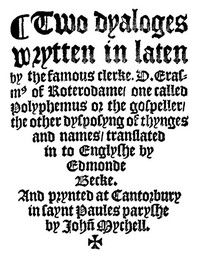
[C]Two dyaloges
wrytten in laten
by the famous clerke. D. Eras-
mus of Roterodame/ one called
Polyphemus or the gospeller/
the other dysposyng of thynges
and names/ translated
in to Englyshe by
Edmonde
Becke.
And prynted at Cantorbury
in saynt Paules paryshe
by Johñ Mychell.
[+]
Lucius Anneus Seneca amonge many other pratie
saienges (gentle reder) hathe this also, whiche in
my iudgement is as trew as it is wittie. Rogãdo
cogit qui rogat superior. And in effecte is thus
moch to say, yf a mãnes superior or his better
desyre any thige, he might aswell cõmãde it by
authoritie as ones to desyre it.
A gentleman a nere cosyn of myne, but moch nerer
in fryndshyp, eftesones dyd instant and moue me to
translate these two dyaloges folowynge, to whose
getlenes I am so moch obliged, indetted and
bounde, that he myght well haue cõmaunded me to
this and more paynes: to whome I do not onely owe
seruyce, but my selfe also. And in accõplysshynge
of his most honest request (partly by cause I
wolde not the moost inhumane fawte of Ingratitude
shuld wor||thely be imputed to me, & that I
might in this thynge also (accordynge to my
bounden dutie) gratifie my frende) I haue hassard
my selfe in these daungerous dayes, where many
are so capcyous, some prone and redy to malygne &
depraue, and fewe whose eares are not so
festidious, tendre, and redy to please, that in
very tryfles & thynges of small importaunce, yet
exacte dylygence and exquisite iudgement is loked
for and requyred, of them whiche at this present
wyll attempte to translate any boke be it that the
matter be neuer so base. But what diligence I have
enployed in the translaciõ hereof I referre it to
the iudgement of the lerned sort, whiche cõferynge
my translacion with the laten dyaloges, I dowte
not wyl condone and pardone my boldnesse, in that
that I chalenge the semblable lybertie whiche the
translatours of this tyme iustlie chalenge. For
some heretofore submytting them selfe to
seruytude, haue lytle ||respecte to the
obseruaciõ of the thyng which in translacyõ is of
all other most necessary and requisite, that is to
saye, to rendre the sence & the very meanyng of
the author, not so relygyouslie addicte to
translate worde for worde, for so the sence of the
author is oftentimes corrupted & depraued, and
neyther the grace of the one tonge nor yet of the
other is truely observed or aptlie expressed. The
lerned knoweth that euery tonge hathe his peculyer
proprietie, phrase, maner of locucion, enargies
and vehemêcie, which so aptlie in any other tõg
can not be expressed. Yf I shal perceyue this my
symple doinge to be thankefully taken, and in good
parte accepted, it shall encorage me hereafter to
attempte the translaciõ of some bokes dysposing of
matters bothe delectable, frutefull, & expedient
to be knowen, by the grace of God, who gyuynge me
quyetnes of mynde, lybertie, and abylytie, shall
not desyste to communicat the frute of my
||spare howers, to such as are not lerned in
the laten tonge: to whome I dedycat the fyrste
frutes of this my symple translacyon.