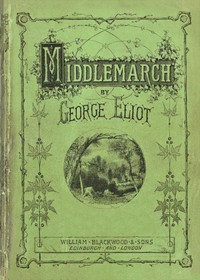
Cover of Middlemarch

Middlemarch

  • Free to read
  • 21 hours to read
  • 88 chapters
  • Reading level: 8th & 9th grade

"Middlemarch" by George Eliot is a novel published in 1871-1872. Set in a fictional English Midlands town from 1829 to 1832, it weaves together multiple intersecting stories exploring the status of women, marriage, idealism, and political reform. The narrative follows Dorothea Brooke's search for purpose, Dr. Lydgate's medical ambitions, and several other inhabitants navigating love, debt, scandal, and social change against the backdrop of the approaching Reform Act of 1832.

Read free now No app, no sign-up. Your place is saved automatically. Or download for your e-reader ↓
  • Didactic fiction
  • City and town life
  • England
  • Young women
  • Love stories
  • Domestic fiction
  • Married people
  • Bildungsromans

Read the opening

Chapter I

Since I can do no good because a woman,
Reach constantly at something that is near it.
—The Maid’s Tragedy: BEAUMONT AND FLETCHER.

Miss Brooke had that kind of beauty which seems to be thrown into relief by poor dress. Her hand and wrist were so finely formed that she could wear sleeves not less bare of style than those in which the Blessed Virgin appeared to Italian painters; and her profile as well as her stature and bearing seemed to gain the more dignity from her plain garments, which by the side of provincial fashion gave her the impressiveness of a fine quotation from the Bible,—or from one of our elder poets,—in a paragraph of to-day’s newspaper. She was usually spoken of as being remarkably clever, but with the addition that her sister Celia had more common-sense. Nevertheless, Celia wore scarcely more trimmings; and it was only to close observers that her dress differed from her sister’s, and had a shade of coquetry in its arrangements; for Miss Brooke’s plain dressing was due to mixed conditions, in most of which her sister shared. The pride of being ladies had something to do with it: the Brooke connections, though not exactly aristocratic, were unquestionably “good:” if you inquired backward for a generation or two, you would not find any yard-measuring or parcel-tying forefathers—anything lower than an admiral or a clergyman; and there was even an ancestor discernible as a Puritan gentleman who served under Cromwell, but afterwards conformed, and managed to come out of all political troubles as the proprietor of a respectable family estate. Young women of such birth, living in a quiet country-house, and attending a village church hardly larger than a parlor, naturally regarded frippery as the ambition of a huckster’s daughter. Then there was well-bred economy, which in those days made show in dress the first item to be deducted from, when any margin was required for expenses more distinctive of rank. Such reasons would have been enough to account for plain dress, quite apart from religious feeling; but in Miss Brooke’s case, religion alone would have determined it; and Celia mildly acquiesced in all her sister’s sentiments, only infusing them with that common-sense which is able to accept momentous doctrines without any eccentric agitation. Dorothea knew many passages of Pascal’s Pensees and of Jeremy Taylor by heart; and to her the destinies of mankind, seen by the light of Christianity, made the solicitudes of feminine fashion appear an occupation for Bedlam. She could not reconcile the anxieties of a spiritual life involving eternal consequences, with a keen interest in gimp and artificial protrusions of drapery. Her mind was theoretic, and yearned by its nature after some lofty conception of the world which might frankly include the parish of Tipton and her own rule of conduct there; she was enamoured of intensity and greatness, and rash in embracing whatever seemed to her to have those aspects; likely to seek martyrdom, to make retractations, and then to incur martyrdom after all in a quarter where she had not sought it. Certainly such elements in the character of a marriageable girl tended to interfere with her lot, and hinder it from being decided according to custom, by good looks, vanity, and merely canine affection. With all this, she, the elder of the sisters, was not yet twenty, and they had both been educated, since they were about twelve years old and had lost their parents, on plans at once narrow and promiscuous, first in an English family and afterwards in a Swiss family at Lausanne, their bachelor uncle and guardian trying in this way to remedy the disadvantages of their orphaned condition.

Keep reading Middlemarch →

Contents

Show all 88 chapters
  1. Front Matter
  2. Book I: Miss Brooke
  3. Chapter I
  4. Chapter II
  5. Chapter III
  6. Chapter IV
  7. Chapter V
  8. Chapter VI
  9. Chapter VII
  10. Chapter VIII
  11. Chapter IX
  12. Chapter X
  13. Chapter XI
  14. Chapter XII
  15. Book II: Old and Young
  16. Chapter XIII
  17. Chapter XIV
  18. Chapter XV
  19. Chapter XVI
  20. Chapter XVII
  21. Chapter XVIII
  22. Chapter XIX
  23. Chapter XX
  24. Chapter XXI
  25. Chapter XXII
  26. Book III: Waiting for Death
  27. Chapter XXIII
  28. Chapter XXIV
  29. Chapter XXV
  30. Chapter XXVI
  31. Chapter XXVII
  32. Chapter XXVIII
  33. Chapter XXIX
  34. Chapter XXX: Qui veut délasser hors de propos, lasse. — Pascal
  35. Chapter XXXI
  36. Chapter XXXII: They’ll take suggestion as a cat laps milk. — Shakespeare: Tempest
  37. Chapter XXXIII
  38. Book IV: Three Love Problems
  39. Chapter XXXIV
  40. Chapter XXXV
  41. Chapter XXXVI
  42. Chapter XXXVII
  43. Chapter XXXVIII
  44. Chapter XXXIX
  45. Chapter XL
  46. Chapter XLI
  47. Chapter XLII
  48. Book V: The Dead Hand
  49. Chapter XLIII
  50. Chapter XLIV
  51. Chapter XLV
  52. Chapter XLVI
  53. Chapter XLVII
  54. Chapter XLVIII
  55. Chapter XLIX
  56. Chapter L
  57. Chapter LI
  58. Chapter LII
  59. Chapter LIII
  60. Book VI: The Widow and the Wife
  61. Chapter LIV
  62. Chapter LV
  63. Chapter LVI
  64. Chapter LVII
  65. Chapter LVIII
  66. Chapter LIX
  67. Chapter LX
  68. Chapter LXI
  69. Chapter LXII
  70. Book VII: Two Temptations
  71. Chapter LXIII: These little things are great to little man. — Goldsmith
  72. Chapter LXIV
  73. Chapter LXV
  74. Chapter LXVI
  75. Chapter LXVII
  76. Chapter LXVIII
  77. Chapter LXIX: “If thou hast heard a word, let it die with thee.” — Ecclesiasticus
  78. Chapter LXX
  79. Chapter LXXI
  80. Book VIII: Sunset and Sunrise
  81. Chapter LXXII
  82. Chapter LXXIII
  83. Chapter LXXIV
  84. Chapter LXXV
  85. Chapter LXXVI
  86. Chapter LXXVII
  87. Chapter LXXVIII
  88. Chapter LXXIX
  89. Chapter LXXX
  90. Chapter LXXXI
  91. Chapter LXXXII: “My grief lies onward and my joy behind.” — Shakespeare: Sonnets
  92. Chapter LXXXIII
  93. Chapter LXXXIV
  94. Chapter LXXXV
  95. Chapter LXXXVI
  96. Finale

Download for your e-reader

Files are provided by Project Gutenberg. On a Kindle, the simplest route is to send the EPUB with Amazon’s Send to Kindle. Downloaded copies don’t sync with your place on Classic Book Reader.

About this edition

This free edition of Middlemarch by George Eliot comes from Project Gutenberg eBook #145, released 1994-07-01. It is in the public domain in the United States, so you can read it here in full at no cost, on any phone, tablet or computer. Genre: Novels, Classics of Literature, British Literature.

Summary provided by Project Gutenberg (automatically generated).

More by George Eliot