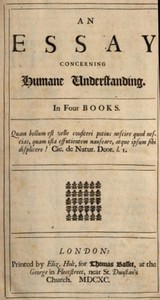
Cover of An Essay Concerning Humane Understanding, Volume 1

An Essay Concerning Humane Understanding, Volume 1

  • Free to read
  • 10 hours to read
  • 36 chapters
  • Reading level: College-level

"An Essay Concerning Humane Understanding, Volume 1" by John Locke is a philosophical work first published in 1689. It challenges the notion that humans are born with innate ideas, arguing instead that the mind begins as a blank slate shaped entirely by experience. Locke examines how we acquire knowledge through sensation and reflection, distinguishes between primary and secondary qualities of objects, and explores personal identity, language, and the nature of understanding itself—laying crucial groundwork for modern empiricism.

Read free now No app, no sign-up. Your place is saved automatically. Or download for your e-reader ↓
  • Knowledge, Theory of · Early works to 1800

Read the opening

Chapter I: Introduction

1. An Inquiry into the Understanding pleasant and useful.

Since it is the UNDERSTANDING that sets man above the rest of sensible beings, and gives him all the advantage and dominion which he has over them; it is certainly a subject, even for its nobleness, worth our labour to inquire into. The understanding, like the eye, whilst it makes us see and perceive all other things, takes no notice of itself; and it requires and art and pains to set it at a distance and make it its own object. But whatever be the difficulties that lie in the way of this inquiry; whatever it be that keeps us so much in the dark to ourselves; sure I am that all the light we can let in upon our minds, all the acquaintance we can make with our own understandings, will not only be very pleasant, but bring us great advantage, in directing our thoughts in the search of other things.

2. Design.

This, therefore, being my purpose—to inquire into the original, certainty, and extent of HUMAN KNOWLEDGE, together with the grounds and degrees of BELIEF, OPINION, and ASSENT;—I shall not at present meddle with the physical consideration of the mind; or trouble myself to examine wherein its essence consists; or by what motions of our spirits or alterations of our bodies we come to have any SENSATION by our organs, or any IDEAS in our understandings; and whether those ideas do in their formation, any or all of them, depend on matter or not. These are speculations which, however curious and entertaining, I shall decline, as lying out of my way in the design I am now upon. It shall suffice to my present purpose, to consider the discerning faculties of a man, as they are employed about the objects which they have to do with. And I shall imagine I have not wholly misemployed myself in the thoughts I shall have on this occasion, if, in this historical, plain method, I can give any account of the ways whereby our understandings come to attain those notions of things we have; and can set down any measures of the certainty of our knowledge; or the grounds of those persuasions which are to be found amongst men, so various, different, and wholly contradictory; and yet asserted somewhere or other with such assurance and confidence, that he that shall take a view of the opinions of mankind, observe their opposition, and at the same time consider the fondness and devotion wherewith they are embraced, the resolution and eagerness wherewith they are maintained, may perhaps have reason to suspect, that either there is no such thing as truth at all, or that mankind hath no sufficient means to attain a certain knowledge of it.
Keep reading An Essay Concerning Humane Understanding, Volume 1 →

Contents

Show all 36 chapters
  1. Front Matter
  2. Book I: Neither Principles Nor Ideas Are Innate
  3. Chapter I: Introduction
  4. Chapter II: No Innate Speculative Principles
  5. Chapter III: No Innate Practical Principles
  6. Book II: Of Ideas
  7. Chapter I: Of Ideas in General, and Their Original
  8. Chapter II: Of Simple Ideas
  9. Chapter III: Of Simple Ideas of Sense
  10. Chapter IV: Idea of Solidity
  11. Chapter V: Of Simple Ideas of Divers Senses
  12. Chapter VI: Of Simple Ideas of Reflection
  13. Chapter VII: Of Simple Ideas of Both Sensation and Reflection
  14. Chapter VIII: Some Further Considerations Concerning Our Simple Ideas of Sensation
  15. Chapter IX: Of Perception
  16. Chapter X: Of Retention
  17. Chapter XI: Of Discerning, and Other Operations of the Mind
  18. Chapter XII: Of Complex Ideas
  19. Chapter XIV: Idea of Duration and Its Simple Modes
  20. Chapter XV: Ideas of Duration and Expansion, Considered Together
  21. Chapter XVI: Idea of Number
  22. Chapter XVII: Of Infinity
  23. Chapter XVIII: Other Simple Modes
  24. Chapter XIX: Of the Modes of Thinking
  25. Chapter XX: Of Modes of Pleasure and Pain
  26. Chapter XXI: Of Power
  27. Chapter XXII: Of Mixed Modes
  28. Chapter XXIII: Of Our Complex Ideas of Substances
  29. Chapter XXIV: Of Collective Ideas of Substances
  30. Chapter XXV: Of Relation
  31. Chapter XXVI: Of Cause and Effect, and Other Relations
  32. Chapter XXVII: Of Identity and Diversity
  33. Chapter XXVIII: Of Other Relations
  34. Chapter XXIX: Of Clear and Obscure, Distinct and Confused Ideas
  35. Chapter XXX: Of Real and Fantastical Ideas
  36. Chapter XXXI: Of Adequate and Inadequate Ideas
  37. Chapter XXXII: Of True and False Ideas
  38. Chapter XXXIII: Of the Association of Ideas

Download for your e-reader

Files are provided by Project Gutenberg. On a Kindle, the simplest route is to send the EPUB with Amazon’s Send to Kindle. Downloaded copies don’t sync with your place on Classic Book Reader.

About this edition

This free edition of An Essay Concerning Humane Understanding, Volume 1 by John Locke comes from Project Gutenberg eBook #10615, released 2004-01-01. It is in the public domain in the United States, so you can read it here in full at no cost, on any phone, tablet or computer. Genre: Philosophy & Ethics.

Summary provided by Project Gutenberg (automatically generated).

More by John Locke